


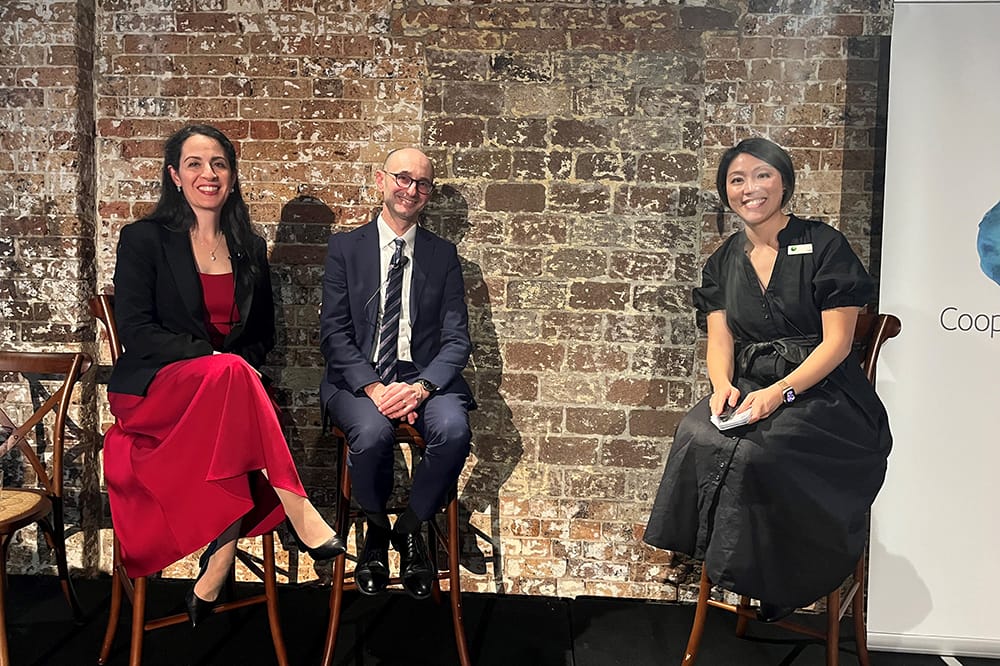
From left: Dr Maria Markoulli, Daniel Tracton and Julia Kwok
Despite torrential rain and train disruptions wreaking havoc across Sydney, 80 dedicated optometrists braved the elements for an evening focussed on presbyopia management and multifocal contact lens solutions.
The event, hosted by CooperVision at Hinchcliff House in May, brought together eye care professionals to explore ‘Perspectives in Presbyopia’ through three distinct lenses: scientific evidence, practical clinical strategies, and product innovation.
only about 11% of patients hear about presbyopia from their clinician before they experience symptoms
Julia Kwok, CooperVision’s Professional Services Manager, opened the evening by challenging attendees to reconsider their approach to presbyopia management. “Tonight we’ve put together an event programme that will allow you to step back and look at presbyopia through a fresh lens,” Ms Kwok explained, setting the stage for presentations from academic Dr Maria Markoulli and optometrist Daniel Tracton.
The Science Behind Success
Dr Maria Markoulli, Associate Professor and Co-Director of Teaching at the School of Optometry and Vision Science at University of New South Wales, delivered a comprehensive overview of current presbyopia correction options, drawing heavily from the recent BCLA CLEAR reports on presbyopia management that she contributed to.
Dr Markoulli observed the significant shift in clinical practice patterns, noting: “This decade, for the first time, we’re seeing a flip from clinicians focussing on monovision to now focussing on multifocal contact lenses, and we are seeing some really interesting results.”
She highlighted a concerning gap in patient education, revealing that according to the World Council of Optometry, “only about 11% of patients hear about presbyopia from their clinician before they experience symptoms. What we know is that patients actually want to know, they want to be forewarned five to 10 years prior.”
Drawing on global research, Dr Markoulli explained that presbyopia affects far more people than previously understood. “Prior to the CLEAR reports, what we thought was that one billion people were affected by presbyopia, but with the revised definition, we now know that’s 2.3 billion. So by 2030 there’ll be about three billion people affected with presbyopia.”
Her presentation covered the various multifocal contact lens designs available, from centre-near and centre-distance lenses to the newer extended depth of focus designs.
While acknowledging that multifocal contact lenses do split the light, causing some light scatter and haloes, and potentially reducing contrast sensitivity, Dr Markoulli said these lenses “are a very good option for presbyopia correction”.
Innovation in Practice
Ms Kwok’s product presentation showcased CooperVision’s comprehensive multifocal portfolio and highlighted the company’s commitment to providing multiple design options. “What we try to do is to continually evolve our designs and give you lots of options because no one lens is going to work for all your patients,” she said, adding that as a result, CooperVision’s Biofinity multifocal range alone has more than 200,000 prescription options available.
Ms Kwok explained that what makes CooperVision’s Biofinity multifocal and Biofinity toric multifocal contact lenses “quite innovative” is the two available lens designs, known as D (centre-distance) and N (centre-near). The D lens prioritises distance vision and the N lens prioritises near.
MyDay multifocal is designed for a very simple fit and to carry a patient right through from early presbyopia into the later stages. As a rule, the low add should always be fitted to the sensory dominant eye and then either the low, medium or high add for the nondominant eye to ensure the patient gets good distance vision quality. “And this is what makes the lens so simple to fit… you only need to worry about whether you are putting low, medium, or high in the nondominant eye,” Ms Kwok said.
Ms Kwok reminded the audience to use CooperVision’s OptiExpert multi-lingual app to calculate the recommended diagnostic contact lens to ensure a very high fitting success rate. “We generally find about eight in 10 patients on that first set of trials that you dispensed are going to be successful once the patient adapts to them; you don’t need to change anything.”
Real-World Clinical Insights
Daniel Tracton, who established Tracton Optometrists in Bondi Junction during the 2021 lockdown, shared practical strategies from his focussed presbyopia campaign, an initiative supported by CooperVision.
Mr Tracton’s approach centres on proactive patient engagement: “I have a bit of a go-to phrase… as a starting point I say to the patient, ‘have you considered contact lenses and specifically, have you considered multifocal contact lenses?’.”
His practice tracked detailed data on presbyopic contact lens fittings, revealing a diverse patient demographic ranging from 40 to 75 years of age, with a notable portion choosing part-time wear. “I think they’re actually quite thrilled that we suggest contact lenses for them,” Mr Tracton observed about patient responses.
Central to his success is his free trial philosophy: “I’m a very, very big fan of free trials of contact lenses… I say there’s no charge if you don’t like them. And if you do like them, you’ll proceed to a teach.” He went on to explain that he does charge patients for teaching and follow-up appointments, as well as auxiliary items such as advanced diagnostic testing
Setting Realistic Expectations
Throughout the evening, the speakers consistently spoke about the importance of using positive language when managing patient expectations. As an example, they suggested that rather than suggesting a patient may experience ‘blurry’ distance vision when first wearing multifocal contact lenses, they might use the term ‘soft focus’.
A panel discussion with Dr Markoulli, Mr Tracton, and Ms Kwok reinforced that successful multifocal contact lens fitting requires patience, with adaptation sometimes taking around two weeks, and that visual acuity measurements alone are poor predictors of patient satisfaction.
Dr Markoulli stressed that “subjective performance, where you ask the patient to give a score out of 10 for questions such as, how are you feeling? What do you think? Would you buy them? is a better indicator than visual acuity… measuring a patient’s visual acuity alone is a poor indicator of fitting success.”
She said, “the optimum contact lens will vary from person to person and the best achievable outcome will also differ between people”.
The evening concluded with practical advice for practitioners looking to expand their presbyopia management, and highlighted the importance of comprehensive dry eye assessments, real-world vision testing, and maintaining detailed patient records to track fitting success.


