


The World Society of Paediatric Ophthalmology and Strabismus (WSPOS) has released an updated Myopia Consensus Statement, listing the actions that work – and those that don’t – in combatting the myopia epidemic.
WSPOS said the interventions described in the consensus statement are based on studies that have shown “statistical and clinical significance” and have at least two years of follow-up with peer-reviewed publication.1
What Doesn’t Work
The WSPOS Consensus Statement noted there have been “numerous methods” yielding “zero to statistically and clinically non-significant effects”. Among these are under correction, pin hole glasses, blue light blocking glasses, bifocal glasses, progressive addition spectacle lenses (PALs), and daytime single vision soft contact or rigid gas permeable contact lenses.
What Appears to Work
The consensus statement listed increased time spent outdoors as well as reduced time on near tasks as effective behavioural / environmental interventions.
The statement discusses spectacles and contact lenses for myopia control and also covers the use of atropine drops.
Significantly, the statement now includes repeated low-level red-light therapy, which has been more recently shown to slow myopia progression.
“There have since been over 20 peer-reviewed papers and over five systematic reviews and meta-analyses published on the effects of RLRL for myopia control,” WSPOS said in the consensus statement.
“It has consistently been shown to slow AL (axial length) elongation, with several papers consistently reporting on a phenomenon of axial shortening up until 12 months.”
RLRL Safety
WSPOS cited a recent systematic review assessing RLRL’s safety across 20 studies — including RCTs and observational designs — which found no cases of permanent vision loss. The overall incidence of side effects was 0.088 per 100 patient-years. There were two case reports describing a single patient experiencing “reversible decline in visual acuity and optical coherence tomography abnormalities that resolved completely after four months cessation of treatment”.
“The incidence of side effects from RLT (red light therapy) was 0.088 per 100 patient-years… comparable to spectacles designed for myopia reduction… and significantly lower than for low-dose atropine… orthokeratology… and other anti-myopia contact lenses…”
Lack of Standardisation
Despite its encouraging results, the consensus statement noted that as a newer treatment modality, there is a “lack of standardisation in the safety evaluation of different manufacturers’ red light devices” with safety concerns about some devices available in China. New national guidelines are expected to pause broader rollout within that market.
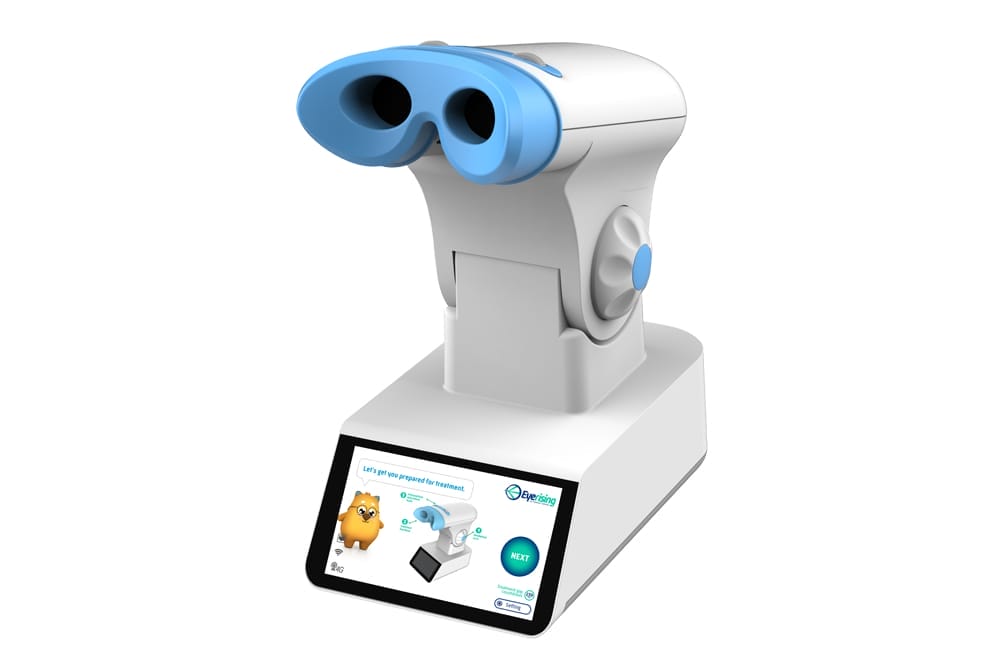
Outside of China, Eyerising International’s device was highlighted as the only RLRL product to have achieved regulatory approval to date, now available in parts of Europe and Asia.
Emerging Therapies
For the first time, WSPOS has released a separate appendix2 for emerging therapies that do not yet meet the criteria to be included in the consensus statement.
These include blue light therapy, and emerging spectacle and contact lens technologies.
Further details are available in the Appendix to the Myopia Consensus Statement.
Australian RLRL Study
Closer to home, interim results from a 12-month randomised controlled trial (RCT) in Melbourne are offering further insight into RLRL’s potential.3 The aim of the study, published in Ophthalmic Epidemiology, was to test whether the benefits seen in previous Chinese studies could be replicated in other ethnic groups, specifically a multi-ethnic Australian school-aged population.
Thirty-four children aged 8–13 years with myopia were enrolled in the study. Participants were randomly assigned to the RLRL group or to a single vision spectacle (SVS) control group. Those in the RLRL group received the therapy twice daily on weekdays for three-minute sessions as well as wearing SVS, while the SVS group continued routine activities.
Assessments were scheduled at baseline and follow-up visits at one, three, six and 12 months, with compliance monitoring and safety assessments throughout.
Study authors reported that 32 of the 34 children (94.1%) participated in the three-month follow-up visit. The RLRL group demonstrated a significant shortening in axial length (AL) (− 0.06 ± 0.05 mm) compared to the SVS group (0.02 ± 0.06 mm, p < 0.001). Similarly, the RLRL group demonstrated a reversal in cycloplegic spherical equivalent (SE) change (0.23 ± 0.18D), whereas the SVS group exhibited a smaller increase (0.04 ± 0.43 D). No severe adverse events were reported in either of the groups.
“This interim analysis substantiates RLRL therapy’s effectiveness and safety in controlling myopia progression. The observed AL shortening, reversal of SE progression, and consistent outcomes across diverse ethnicities suggest the potential of RLRL therapy as a globally applicable solution for myopia control,” Eyerising International said.
“Anticipating the one-year results, we look forward to continued demonstration of RLRL’s strong treatment effect in non-Chinese populations.”
References
- World Society of Paediatric Ophthalmology and Strabismus, Myopia Consensus Statement 2025, 28 May 2025, available at: https://wspos.org/myopia-consensus-statement-2025/ [accessed May 2025].
- World Society of Paediatric Ophthalmology and Strabismus, Myopia Consensus Statement 2025, Final Appendix, 28 May 2025, available at: https://wspos.org/wp-content/uploads/2025/05/Myopia-Consensus-Statement-2025-Final-Appendix.pdf [accessed May 2025].
- Deen N, Zhu Z, He M, et al. Three-month interim analyses of repeated low-level red-light therapy in myopia control in schoolchildren: A pilot multi-ethnic randomized controlled trial. Ophthalmic Epidemiol. 2025 May 19:1-9. doi: 10.1080/09286586.2025.2500020. Epub ahead of print.


