


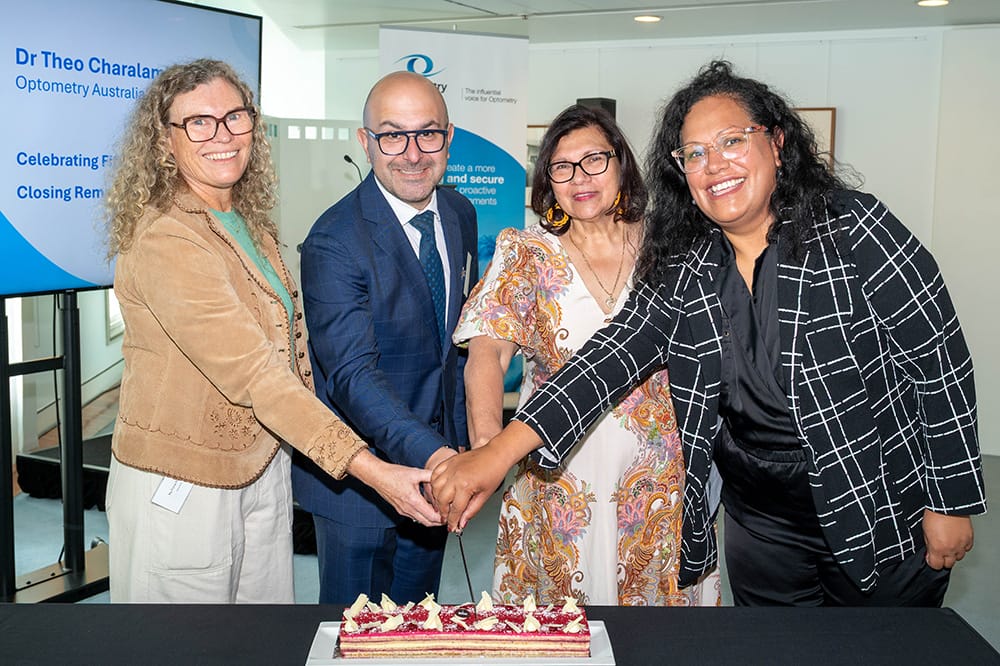
From left: Fiona Moore (Optometry Queensland Northern Territory Board Director), Theo Charalambous (Optometry Australia President), Monica Barolits-McCabe (Executive Director, NACCHO), and Lose Fonua (CEO, First Nations Eye Health Alliance).
Australia’s Visiting Optometrists Scheme (VOS) has turned 50.
The milestone was celebrated by Optometry Australia at an event in Parliament House, Canberra, during the last week of October.
Established in 1975, the federal government funds a range of essential costs for VOS including travel, accommodation, facility use, administrative support, and equipment transport. This enables optometrists to provide high-quality care to Australians in remote locations who face significant barriers to treatment, ensuring they receive timely, culturally safe eye care that might otherwise be out of reach.
By supporting optometrists to deliver outreach services, Sarah Davies, Director of Advocacy at Optometry Australia said, “The VOS has transformed eye care in regional, rural, and remote communities”.
“It ensures Australians who might never otherwise see an optometrist can get the care they need, when and where they need it.”
The program also strengthens connections between visiting optometrists, local health providers, and other visiting health professionals, improving care coordination and ongoing patient support.
“Outreach eye care is about more than sight. It’s about wellbeing, education, independence, and quality of life. VOS ensures communities that are often overlooked are not left behind.”
More than a Program: A Lifeline

Event speakers, clockwise from top left: Lose Fonua, Senator the Hon Anne Ruston, Fiona Moore, and Monica Barolits-McCabe.
Expanded in 2009–10 to enhance services for First Nations communities, VOS has played a critical role in early detection of eye disease, timely referrals, and continuity of care.
In a statement, Optometry Australia acknowledged that First Nations leadership and self-determination in the design and delivery of the scheme has been essential to ensure the program continues to evolve and meet the needs of Aboriginal and Torres Strait Islander Peoples.
This commitment was strongly echoed by Monica Barolits-McCabe, Executive Director of NACCHO, and Lose Fonua, CEO of the First Nations Eye Health Alliance, who spoke at the Parliament House event about the importance of partnership, respect, and community-led approaches to eye health.
The VOS is more than a program; it’s a lifeline, ensuring every Australian can see well and live well
“This celebration is about recognising the incredible contribution of optometrists and health teams who deliver essential eye care to underserved communities – both those in rural and remote locations and Aboriginal and Torres Strait Islander Peoples across the country. The VOS is more than a program; it’s a lifeline, ensuring every Australian can see well and live well,” Ms Davies said.
Calls for Sustainable Funding
In August 2025, Optometry Australia undertook a national survey of VOS optometrists, to understand their perspectives of the scheme. While most providers expressed strong satisfaction with the purpose and impact of the program, only 16% felt the current funded activities reflect their actual outreach work, and just 21% considered remuneration rates adequate.
“The VOS enters a new funding period from 1 July 2026. As we look to the future, Optometry Australia is calling for the VOS to be sustainably funded beyond 2026, aligned with population need and informed by provider experience and First Nations leadership,” OA said.
More information about the Visiting Optometrists Scheme is available online.