


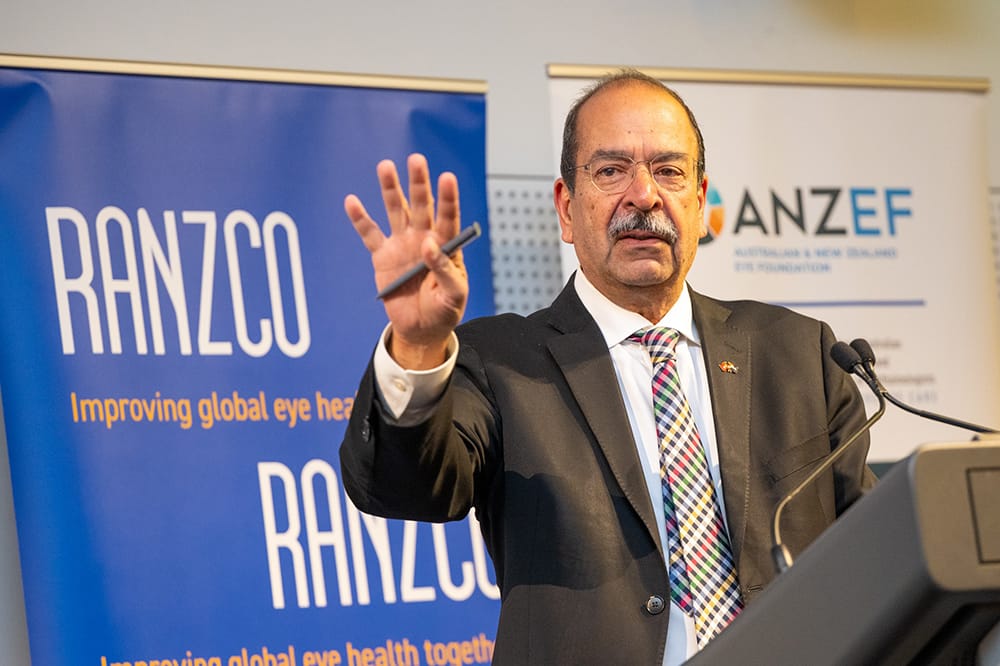
Prof Nitin Verma, convenor of the GEHW. Photo courtesy of RANZCO.
The annual Global Eye Health Workshop (GEHW) held on 14 November in Melbourne, convened by Professors Nitin Verma (Hobart) and Mark Radford (Brisbane), brought together ophthalmologists from Australia, New Zealand, the Pacific and Asia to examine challenges, innovations and opportunities in global ophthalmology.
Diagnosis and Management in Low-Resource Settings
One of the leading causes of avoidable blindness in the Pacific is corneal disease, driven by infectious, nutritional and immunologic factors. During the first session, speakers focussed their attention on access barriers – particularly inconsistent availability of antifungals and antivirals, limited pathology testing, and late patient presentation – that undermine the timely treatment crucial for preventing irreversible visual loss.
The value of autologous corneal tissue techniques as a cost-effective and practical alternative to conventional transplantation was described by Professor Rasik Vajpayee (Melbourne), who emphasised their benefits when access to donor tissue is limited, and patients are at high risk of graft rejection.
Dr Jambi Garap (Papua New Guinea) described a preventable epidemic of paediatric lime-burn injuries linked to betel-nut preparation practices, and highlighted the difficulty of managing complex corneal infections when children present late and essential medications are hard to source. Case studies of severe keratitis, presented by Dr Alma Nacuva (Fiji), demonstrated the challenges of managing this complex condition with restricted pharmaceutical availability.
In reporting encouraging gains in cataract outcomes in PNG, despite significant comorbidity burdens and increasing surgical demand, Dr Robert Ko (PNG) stressed that sustaining these improvements will require ongoing investment in training and clinical standards.
speakers emphasised the need for an integrated and equity-focussed strategy, combining culturally appropriate health promotion, education, school and community-based screening
The Challenge of Keratoconus
The second session focussed on keratoconus, which continues to be diagnosed late in many communities, particularly among Māori, Pacific and rural populations in New Zealand and across the Pacific due to limited access to specialist care, low awareness and other systemic barriers. Planning and advocacy efforts are complicated by the lack of population-level data, but speakers emphasised the need for an integrated and equity-focussed strategy, combining culturally appropriate health promotion, education, school and community-based screening, and funded pathways for early intervention.
A strong case for keratoconus screening in New Zealand was presented by Dr Alistair Papali’i-Curtin (Wellington), whose research suggests the condition affects approximately 1% of 15-year-olds – a higher prevalence than breast and bowel cancer, both of which are covered by population screening programs. Keratoconus screening at age 15 could significantly reduce preventable vision loss, curb the need for corneal transplantation and support a more equitable distribution of care.
Innovations in Ophthalmic Training
Session 3 showcased innovations enabling high-quality ophthalmic training and service delivery in low-resource environments.
This included a presentation by Prof Michael Coote (Melbourne) on GONE (glaucomatous optic neuropathy evaluation project) an online training and benchmarking platform now used by more than 2,500 eyecare professionals. Designed to provide structured training in grading optic disc photographs, it enhances diagnostic consistency and supports more accurate glaucoma detection.
In regional India, a tele-ophthalmology model developed with Aravind Eye Care, allows RETCAM images to be downloaded to mobile phones and assessed remotely by paediatric ophthalmologists. Dr Rodney Morris (India) reported that around 600 trained mid-level ophthalmic personnel operate these retinal cameras, extending specialist oversight to populations of roughly 150,000 and reducing the need for direct specialist involvement while maintaining robust quality assurance.
Global education and capacity-building efforts were outlined by Dr Anna Tan (Singapore), whose work through the Singapore National Eye Centre in ASEAN countries and Pacific nations includes workforce training, implementation support, and AI-enabled screening programs in resource-limited settings.
Innovative use of messaging platforms was highlighted by Dr Jason Cheng (Sydney), who examined how WhatsApp groups can facilitate remote consultation, case sharing under quality controls, and peer learning. By training clinicians and non-medical graders, and by providing e-driven guidelines accessible via QR codes, this model offers a flexible telehealth solution that can be readily adapted for Pacific ophthalmic services.
Collaboration and Regional Leadership
The last session focussed on collaboration and regional leadership. Dr Alma Nacuva (Samoa) highlighted the importance of the recent PacEYES meeting in Apia, noting the strong support from the Royal Australian and New Zealand College of Ophthalmologists (RANZCO). She observed the critical role of nurses as the bridge between ophthalmologists and patients, and outlined PacEYES’ evolving focus connection, learning, representation, and coordination, aiming to strengthen partnerships, expand training opportunities and build a cohesive regional voice for Pacific eye health professionals.
Dr John Kennedy (Sydney) discussed the contributions of the ANZEF in addressing community needs across the region and Mr Brandon Ah Tong (International Agency for the Prevention of Blindness, Melbourne) delivered key messages on global priorities. These include: the 2026 Global Summit for Eye Health in Antigua and Barbuda; new evidence showing a US$28 return for every US$1 invested in eye health; and the potential for a US$7.1B investment to reduce global vision impairment by 25% by 2030. Urgent priorities include myopia control, acceleration of cataract outreach, and development of AI standards to support the World Health Organization’s SPECS 2030 initiative.
Overall, the meeting, held in the lead-up to RANZCO Congress in November in Melbourne, underscored the significant contributions of RANZCO Fellows –about 300 in total, who play a role in global eye health. The strong engagement demonstrated commitment to improving equity, access and outcomes across the Pacific and beyond.
Gerhard Schlenther is Head of Policy and Advocacy at RANZCO.

Dr Rajik Vajpee presenting on surgical management of corneal disease in low-resource settings. Photo provided courtesy of RANZCO.

Prof Nitin Verma, convenor of the GEHW. Photo courtesy of RANZCO.

Speakers and panelists, Dr Robert Ko and Dr Alma Nacuva. Photo provided courtesy of RANZCO.

Dr Alistair Papali'i-Curtin presenting on keratoconus status in New Zealand. Photo provided courtesy of RANZCO.


