


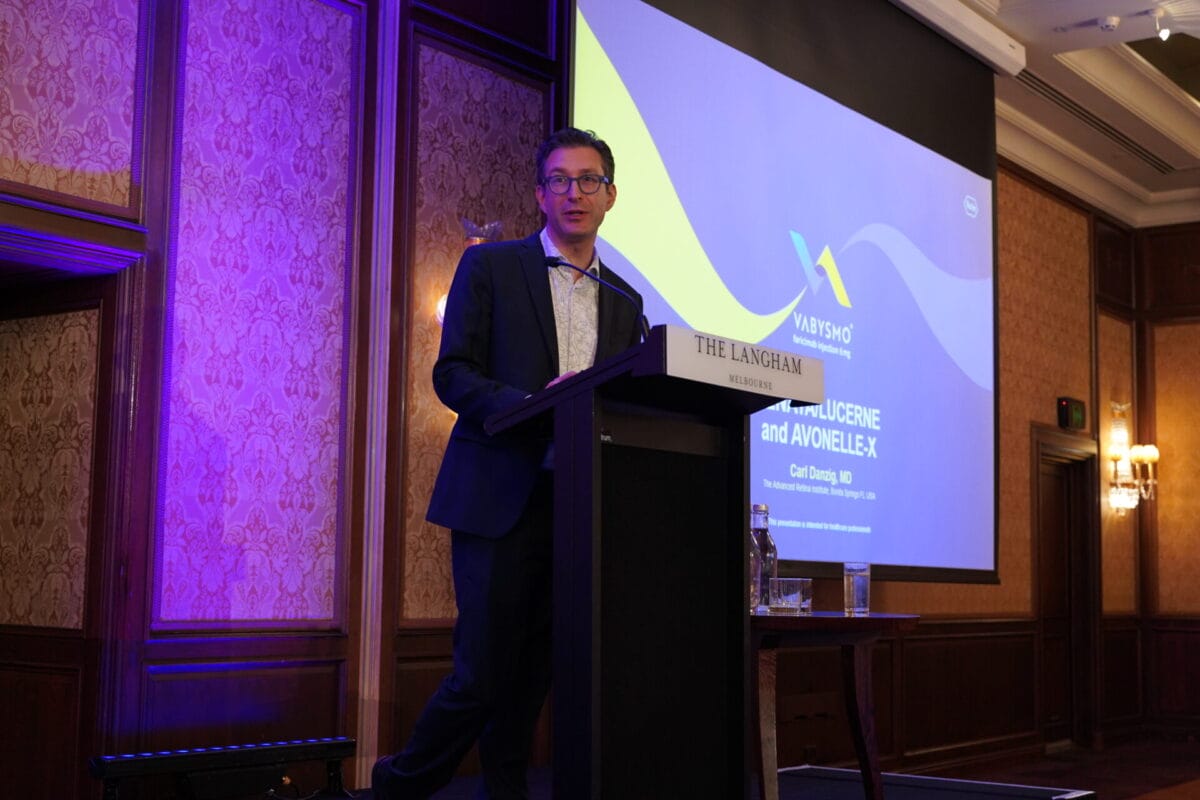
Dr Carl Danzig
The latest approaches to managing neovascular (wet) age-related macular degeneration (n-AMD) were discussed by ophthalmologists from across Australia, New Zealand, Singapore and the United States at a Roche-hosted dinner symposium during the 2025 Royal Australian and New Zealand College of Ophthalmologists (RANZCO) Congress.
Chaired by Professor Robyn Guymer AM from the Centre for Eye Research Australia and the University of Melbourne, the evening featured an expert panel comprising Dr Carl Danzig from Florida (United States), Associate Professor Anna Tan from Singapore National Eye Centre, Dr David Sousa from the Royal Victorian Eye and Ear Hospital, Dr Alex Tan from Monash Health, and Dr James Wong from Sydney Retina.
The symposium, attended by ophthalmologists and nurse practitioners, combined presentations on recent trial data with detailed case study discussions that highlighted practical treatment strategies for eye health professionals managing patients with n-AMD.
The symposium… combined presentations on recent trial data with detailed case study discussions that highlighted practical treatment strategies for… managing patients with n-AMD
Sustained Benefits in Extension Trial Data
Dr Danzig presented data from the AVONELLE-X extension study,1 which followed patients treated with faricimab up to Q16W or aflibercept Q8W from the TENAYA and LUCERNE trials for an additional two years.2 He reported that the results demonstrated that faricimab maintained vision gains and anatomical improvements over the long term, with 75% of patients achieving 20/40 vision or better at one year, and maintaining that vision to four years, regardless of their initial treatment arm.
Particularly noteworthy was the durability of treatment intervals, with 78% of patients extending to 12 weeks or longer in the extension phase. Perhaps most striking was the finding that 44% of patients who had persistent fluid on aflibercept 2 mg every eight weeks at the end of the TENAYA and LUCERNE trials experienced a complete resolution of fluid after switching to faricimab.
“We do not see the typical dropoff in vision that we often observe in long-term extension studies,” Dr Danzig noted, adding that patients in the extension trial received an average of seven injections annually, maintaining disease control with fewer treatment visits.
The safety profile remained consistent throughout, with zero cases of retinal vasculitis reported among the 1,025 patients (520 from the faricimab arm plus 505 from the aflibercept arm), who completed the extension phase.
Personalised Treatment Approaches
Via a series of case presentations, panel members shared their varying approaches to interval extension when switching anti-VEGF agents. Some advocated for immediate four-week extensions with second-generation agents, while others preferred two-week increments when switching due to persistent fluid versus maintaining the failed interval when switching to achieve longer durations.
One straightforward case demonstrated successful extension from six-week intervals to 16 weeks following a switch from aflibercept to faricimab, with vision improving from 6/18 to 6/6 over a two-year period.
A type three neovascularisation case from Singapore showed rapid resolution of fluid and vascularisation after just one faricimab loading dose, with successful extension to 11 weeks and plans to extend further to 14 weeks. This aggressive extension strategy sparked discussion about treatment personalisation based on lesion type.
However, not all cases followed a smooth trajectory. One challenging case involved a patient requiring 28 bevacizumab and eight ranibizumab injections before switching to faricimab, which finally achieved a dry retina at 12-week intervals. This case was a useful reminder that some patients with highly active lesions require ongoing frequent treatment despite second-generation agents.
The Fluid Debate: To Treat or Not to Treat
One of the evening’s most engaging discussions centred on managing subretinal fluid. When asked whether stable subretinal fluid warranted continued treatment, Prof Guymer referenced the FLUID study conducted in Australia,3 which demonstrated that tolerating stable subretinal fluid could actually result in better visual acuity outcomes.
“Not all subretinal fluid implies VEGF activity,” Prof Guymer explained, noting the importance of distinguishing between active disease and stable fluid that may represent mature vessels occasionally oozing transudates. The panel agreed that intraretinal fluid secondary to VEGF activity should be treated, while stable subretinal fluid might be monitored rather than aggressively chased.
The audience heard that approximately half of the American Society of Retina Specialists also tolerate some fluid, while the other half pursue complete dryness.
Polypoidal Choroidal Vasculopathy: Diagnosis Without ICG
The symposium also addressed polypoidal choroidal vasculopathy (PCG), a condition particularly prevalent in Asian populations. With indocyanine green (ICG) angiography not widely available, the panel discussed the Asia-Pacific Ocular Imaging Society’s nine structural optical coherence tomography features that can help identify PCV, including sharp-peaked pigment epithelial detachments, sub-RPE ring-like structures, and double-layer signs.4
Early data on faricimab in PCV showed promising results, with 61% complete polyp regression and 86% inactivation of polyp lesions at one year.5
Managing RPE Tears
Discussion of fibrovascular pigment epithelial detachments (PEDs) raised concerns about retinal pigment epithelium tears. The panel agreed that tear risk relates to PED height and morphology rather than choice of anti-VEGF agent. Sharp-peaked PEDs and those with underlying membranes appear higher risk, while multilayered PEDs tend towards greater stability.
Importantly, Prof Guymer cautioned that tears often precipitate the initial presentation but may be obscured by haemorrhage until after the first injections help clear the blood and reveal the pre-existing tear.
The symposium concluded with an acknowledgement that while second-generation anti-VEGF agents offer improved durability and outcomes, individualised treatment remains essential. Not every patient responds identically, and identifying which patients benefit most from specific agents remains an important area for future research.
References
- Sheth, V et al. Four-year outcomes of faricimab in nAMD: Safety and efficacy results from the AVONELLE-X long-term extension trial. Presented at the 25th EURETINA Congress, Paris, France, 4–7 September 2025.
- Khanani AM, Kotecha A, TENAYA and LUCERNE Investigators, et al. TENAYA and LUCERNE: Two-year results from the phase 3 neovascular age-related macular degeneration trials of faricimab with treat-and-extend dosing in year 2. Ophthalmology. 2024 Aug;131(8):914-926. doi: 10.1016/j.ophtha.2024.02.014.
- Guymer RH, Markey CM, FLUID Investigators, et al. Tolerating subretinal fluid in neovascular age-related macular degeneration treated http://10.1016with ranibizumab using a treat-and-extend regimen: FLUID study 24-month results. Ophthalmology. 2019 May;126(5):723-734. doi: 10.1016/j.ophtha.2018.11.025.
- Cheung CMG, Lai TYY, Lee WK, et al. Polypoidal choroidal vasculopathy: Consensus nomenclature and non-indocyanine green angiograph diagnostic criteria from the Asia-Pacific Ocular Imaging Society PCV workgroup. Ophthalmology. 2021 Mar;128(3):443-452. doi: 10.1016/j.ophtha.2020.08.006.
- Lai, TYY et al. Faricimab for polypoidal choroidal vasculopathy: 1-year results from the phase 3b/4 SALWEEN trial. Presented at the 25th EURETINA Congress, Paris, France, 4–7 September 2025.


