


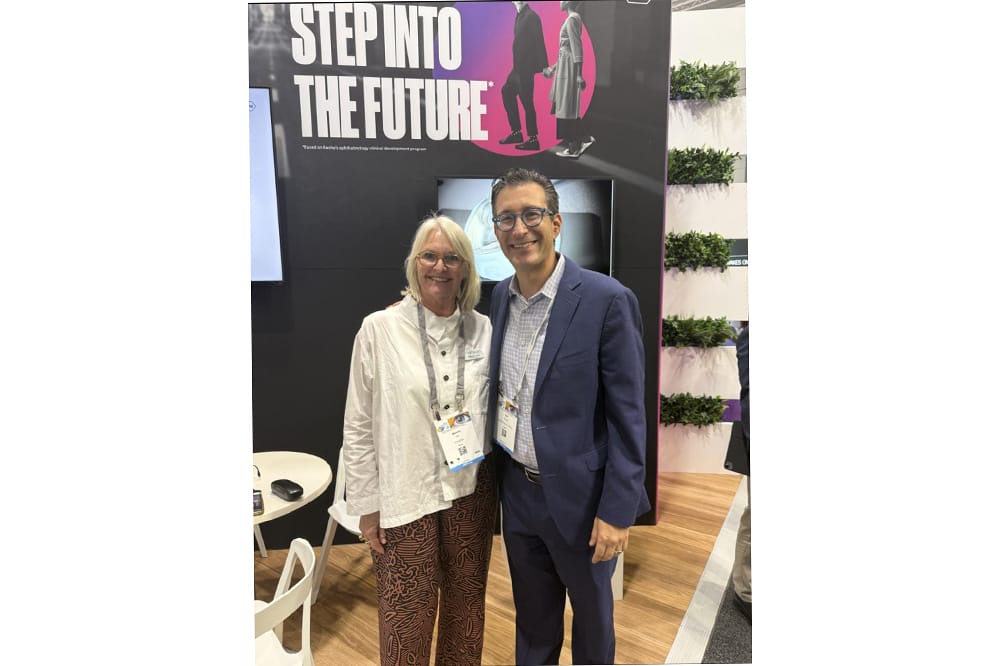
Melanie Kell with Dr Carl Danzig
Dr Carl Danzig is a vitreoretinal surgeon and clinical researcher from the United States who has served as principal investigator for nearly 60 clinical trials. A Fellow of the American Society of Retina Specialists (ASRS) and member of the Retina Society, he was the first physician to perform subretinal gene therapy surgery for geographic atrophy in South Florida. mivision caught up with Dr Danzig to discuss his approach to clinical practice, real-world outcomes, and the future of retinal medicine.
Q. Can you describe your approach to balancing clinical practice with research?
My mentality has always been to advance the field. If I repair someone’s retinal detachment, I can change the world for them. But if I can run a good clinical trial, I can be part of the story that changes the way medicine is practised. I have been principal investigator in 59 trials, and that has given me great joy because it has allowed me to network, collaborate, and innovate with retina specialists around the world. It has also allowed me to maintain an academic presence while in private practice – I didn’t want to give up my academic streak just because I was in the private sector.
Q. How does real-world data compare with clinical trial results?
Traditionally, long-term extension studies and real-world studies do not match clinical trials. Clinical trial patients are the unicorns of our practice – they come in for monthly visits, they’re monitored frequently, and there are strict exclusion and inclusion criteria. However, what we saw with faricimab (for the treatment of neovascular age-related macular degeneration (n-AMD)) in the AVONELLE-X study1 and RHONE-X2 study for diabetic macular oedema (DMO) is similar for both the extension trials and real-world outcomes. When we look at real-world data from the TRUCKEE study,3 what we saw parallels the clinical trial outcomes. That’s reassuring because traditionally that wasn’t the case – in previous studies, patients in long-term extension trials would have their vision tail off because they weren’t injected or monitored as often.
Q. Does this data reassure you when using faricimab in clinic?
Absolutely. I was one of the first presenters for the TRUCKEE study,3 where we examined real-world safety and efficacy of faricimab (for the treatment of nAMD). I presented that at [the] ASRS conference in 2022 in New York at the opening session – it was a physician-sponsored study with no industry support. This came on the heels of brolucizumab, which had major safety concerns, and we demonstrated good safety in our study. It’s not to say some patients couldn’t have a safety issue – there is a warning that around one in 59,000 could have a serious intraocular inflammation event – but those numbers, while we should not dismiss them, are still low.
Q. Given the safety profile, do you start treatment-naïve patients on faricimab?
I think the risk is low. When we’re talking about the risk we saw with brolucizumab, it was much higher. The risk we saw in the real world with pegcetacoplan was higher. The risk with faricimab is quite low, and I have no qualms or hesitation to start any treatment-naïve patient on faricimab for RVO, diabetic macular oedema, or wet AMD, which is the most common. In the United States, we sometimes have to do step therapy depending on insurance, and there are copays – it’s not the same system as in Australia or New Zealand. But if I had my choice, I’d pick a second-generation medication. I generally like having dual inhibition with faricimab.
Q. How do you determine which patients respond better to different treatments?
I don’t fully understand why some patients need a higher molar dose of anti-VEGF – why they do better with aflibercept 8mg– and others need dual inhibition with faricimab. I find more patients generally do better with dual inhibition, but some don’t do as well with faricimab as they do with high-dose aflibercept. What I know is that we have options, and we need to figure out which medicine works best for which patient. In the faricimab RVO studies, there was a pre-specified endpoint at week 24 examining macular leakage on fluorescein angiography. Patients receiving faricimab had a higher incidence of absence of macular leakage, which correlated with fewer injections and longer durability. I find this to be an important biomarker that correlates with durability and visual outcomes.
Q. What does truly personalised treatment look like in retina?
To achieve truly personalised treatment, we need research to identify which biomarkers some people have that others don’t. We need to understand the biology of the person sitting in front of us. And then we need to find out which drug works best for which patient – if we know that in advance, we can go straight to that medication.
There are ethnic factors to consider. Years ago, the Los Angeles Latino Eye Study4 examined which ethnic backgrounds had more proclivity to bleed versus develop tractional retinal detachment. We have the AFED study5 looking at minority patients – African Americans, Afro-Caribbeans, Latin Americans. The more investment in that research, the better for patients. I also think we need more principal investigators from different backgrounds because patients feel comfortable going to a doctor they can relate to.
Q. How do you see artificial intelligence (AI) and emerging therapies shaping the future of retina?
AI for detection and management is an up-and-coming idea in retina, and I think it is the future. It’s in its infancy, but it’s going to grow, and the investment is worthwhile. Beyond AI, there’s a lot to look at: tyrosine kinase inhibitors, gene therapy, and the port delivery system. There are challenges for all of these – people have concerns – but we need to find out which product is best for which patient. Do I see a time when there won’t be a need for injections? No. Even if a treatment decreases persistent fluid by 44%, as we saw in the AVONELLE-X trial, that still leaves 56% of people with persistent fluid. There’s still plenty of work to go around.
Q. What’s your outlook for the field?
The future is bright, and it’s bright for our patients, most importantly. We love it as retina specialists – we’re innovative, scientific, and entrepreneurial. But in the end, it comes down to the patient. We’re going to be able to help them more and more, and not just give them good outcomes early. We’re going to achieve sustained outcomes with good vision and better durability with safe products. I tell my patients: it is because of you that we have these medications on the market. That’s very rewarding.
*mivision interviewed Dr Danzig during the RANZCO 2025 Congress in Melbourne.
References
- Hoffman-La Roche. A study to evaluate the long-term safety and tolerability of faricimab in participants with diabetic macular edema (Rhone-X) (NCT04432831). Trial ongoing. Available at clinicaltrials.gov/study/NCT04432831 [accessed Dec 2025].
- Hoffman-La Roche. A study to evaluate the long-term safety and tolerability of faricimab in participants with neovascular age-related macular degeneration (AVONELLE-X). Trial ongoing. Available at clinicaltrials.gov/study/NCT04777201 [Accessed Dec 2025]
- Penha FM, Masud M, Khanani AM, et al. Review of real-world evidence of dual inhibition of VEGF-A and ANG-2 with faricimab in NAMD and DME. Int J Retina Vitreous. 2024 Jan 17;10(1):5. doi: 10.1186/s40942-024-00525-9.
- Varma R, Paz SH, Los Angeles Latino Eye Study Group, et al. The Los Angeles Latino Eye Study: design, methods, and baseline data. Ophthalmology. 2004 Jun;111(6):1121-31. doi: 10.1016/j.ophtha.2004.02.001.
- McKean-Cowdin R, Fairbrother-Crisp A, African American Eye Disease Study Group,et al. The African American Eye Disease Study: design and methods. Ophthalmic Epidemiol. 2018 Aug;25(4):306-314. doi: 10.1080/09286586.2018.1454965.


