


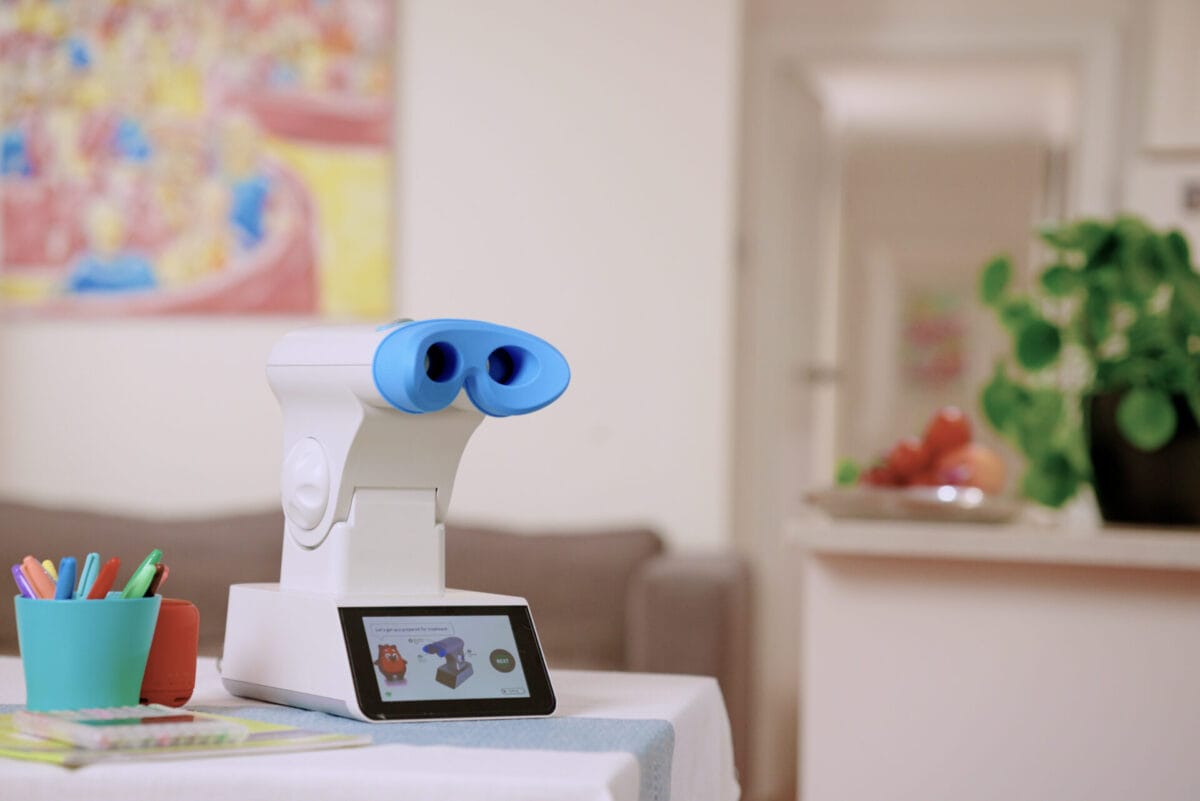
Professor Mingguang He, Chief Medical Officer of Eyerising International has issued a statement in response to a study published in JAMA Ophthalmology.1 The Brief Report suggested that “the widely used Eyerising Myopia Management Device (EMMD) reached ANSI safety limits for exposure times below the recommended 180-second treatment duration”.
Led by Dr Lisa Ostrin, a professor of optometry, and senior research scientist Dr Alexander Schill, both from University of Houston, the study assessed the optical output and safety classification of four commercially available red light therapy devices for myopia management – the Sky-n1201, Future Vision, EMMD, and AirDoc instruments – using American National Standards Institute (ANSI) guidelines.
The authors reported that “the Sky-n1201 and EMMD reached ANSI group 1 limits within exposure times of 2.8 and 1.4 seconds, respectively, for a 7 mm pupil” and classified them as Class 1 and 2M laser devices, respectively. “The Future Vision device reached group 1 limits under extended exposure times of 253 seconds or longer but remained within limits for Class 1 laser classification. The light-emitting diode–based AirDoc produced diffuse illumination with a time to group 1 limit of 22,761 seconds, classifying it as group 1.”
Modelling Questioned
While acknowledging “the author’s efforts in contributing to the ongoing scientific discussion surrounding repeated low-level red-light (RLRL) therapy”, Prof He questioned “whether the radiometric calculations and hazard modelling” used in this study fully accounted for “the specific optical and physiological conditions under which EMMD is used in clinical practice”.
He observed that “accurate assessment of retinal hazard requires detailed consideration of beam geometry, pupil dynamics, fixation behaviour, and established biological injury thresholds – areas that fall within the domain of laser bioeffects and radiation safety expertise”.
Prof He referred to an independent analysis of the EMMD recently presented at the 41st Asia-Pacific Academy of Ophthalmology (APAO) 2026 by Emeritus Professor of Ophthalmology John Marshall, “a pioneer in ophthalmic laser science”, and Dr Karl Schulmeister, “a leading authority in international laser safety standards”.
While the final manuscript is yet to be published, Prof He said their “evaluation, based on established retinal damage thresholds, experimental data, and comparison of therapeutic exposure levels with known hazard limits, concluded that when EMMD is used as intended, the risk of retinal injury is negligible”. Their interim presentation can be viewed here.
In his response, Prof He explained considerations when interpreting laboratory hazard classifications in the context of RLRL as a therapeutic modality, and noted that to date, more than 30 independent clinical studies have evaluated EMMD, collectively reporting efficacy and an exceptional safety profile under Eyerising treatment protocols. As of now, EMMD is the only RLRL therapy device that holds regulatory approvals in multiple international jurisdictions.
“Published longitudinal data extend to three years, with five-year follow-up data currently in preparation,” he wrote.
“In real-world clinical adoption involving more than 110,000 individuals, post-market surveillance has not identified confirmed cases of permanent, vision-threatening retinal injury when RLRL is administered according to protocol. The case report published in JAMA Ophthalmology represents the only documented instance in which a single case of non-permanent visual acuity compromise was reported in association with RLRL exposure, and questions regarding causality remain under scientific discussion.
“As with all medical therapies, RLRL is not expected to be entirely free of adverse events. The relevant clinical question is not whether risk is zero, but whether the benefit–risk balance is favourable. It is also essential to distinguish between transient (and possibly positive) biological responses to treatment and true pathological injury. Appropriate patient selection, adherence to treatment protocols, and ongoing clinician follow up remain critical to ensuring that therapeutic benefit outweighs potential risk.”
Prof He concluded that “continued independent research, transparent reporting, and collaborative scientific engagement will further refine the appropriate safety evaluation frameworks for therapeutic laser applications”.
“We remain committed to rigorous clinical investigation, open dialogue with researchers and regulators, and responsible deployment of RLRL in myopia management,” he stated.
The complete letter can be accessed here.
Reference
- Ostrin LA, Schill AW. Safety Evaluation of 4 Red Light Therapy Devices for Myopia. JAMA Ophthalmol. 2026 Feb 5:e255660. doi: 10.1001/jamaophthalmol.2025.5660. Epub ahead of print. PMID: 41642586; PMCID: PMC12878638.


