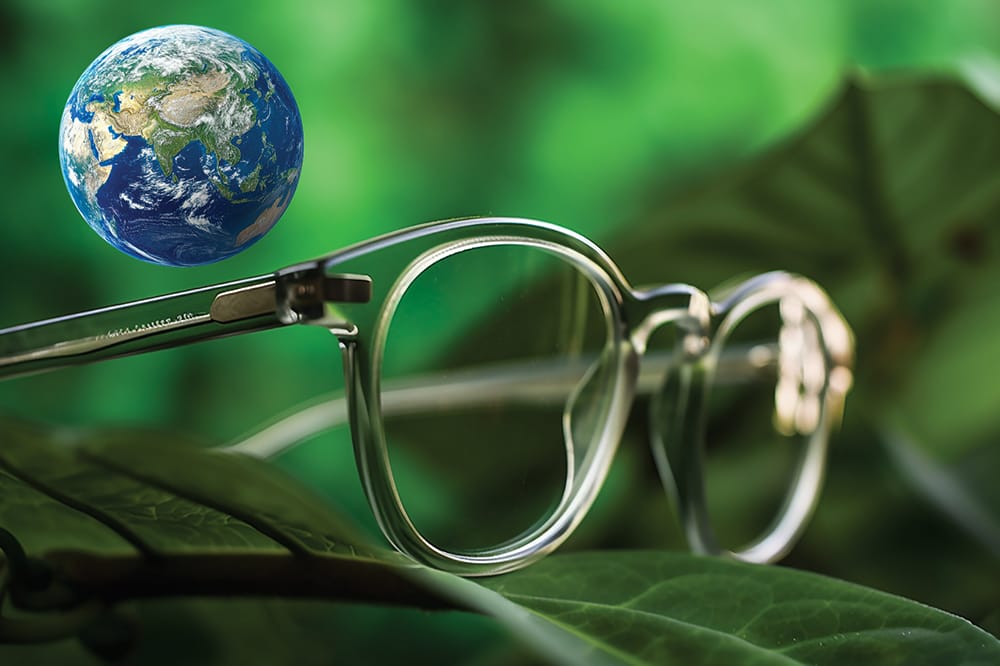
We live in a time where almost everyone is eco-conscious and looking for ways to reduce waste and our carbon footprint. Consumers are focussed on sustainability, and recycling is being incorporated into manufacturing production and waste removal.
As Rayleen Tamblyn writes, the optical industry is no exception.
As awareness of sustainability continues to grow, it is clear that optical frame and lens manufacturers are getting on board the sustainability train. We are seeing the incorporation of innovative bio-based materials in frames, lenses, packaging, and accessories. We are also seeing some impressive advances in manufacturing processes with the focus on energy efficiency, reduced water wastage, waste reduction management, and waste recycling with, for example, swarf being made into pavers, bricks, and laminates.
What Makes a Frame ‘Sustainable’?
Until recently the focus has been on bio-degradable and more eco-friendly frame materials.
Most major frame manufacturers have adopted bio-acetate or recycled materials for their frames, offering stylish and eco-friendly options for consumers.
Bio-acetate is a sustainable alternative to traditional acetate, made from plant-based materials like cotton and wood pulp.
Unlike petroleum-based plastics, bio-acetate is biodegradable, reducing environmental impact.1
Recycled materials are increasingly being used, most often plastics such as reused water bottles and marine traceable plastics. As an example, Good Citizens Eyewear frames are made from 100% recycled plastic, specifically from discarded plastic water bottles. The company has engineered a process where one plastic bottle is enough to create one complete pair of glasses.
Some eyewear brands are addressing ocean plastic pollution by creating frames from traceable marine plastics and recovered fishing gear, including nets. This process helps to reduce marine waste and promotes a circular economy.
With over 10 million spectacle frames being sold in Australia each year, this is a lot of waste when they come to the end of their life
In Australia, we have a new brand championing sustainable eyewear manufacture: Spexcycle.
Spexcycle is Australia’s first closed-loop eyewear recycling programme, founded by Chris Savage, an experienced optical dispenser and designer. Through a streamlined collection process, Spexcycle transforms old frames into new, sustainable eyewear, reducing landfill waste and conserving natural resources.2
“While some manufacturers are stepping up with eco-friendly materials, eyewear waste remains a massive problem,” Mr Savage said. “With over 10 million spectacle frames being sold in Australia each year, this is a lot of waste when they come to the end of their life. By recycling these frames, we reduce the need for virgin plastics and reduce the environmental impact.”
By recycling these frames, we reduce the need for virgin plastics and reduce the environmental impact
How is Eyewear Being Recycled?
Spexcycle’s process can be broken down into four steps:
Disassembly and sorting. Frames are broken down into individual components and carefully sorted by materials, type, and colour.
Material repurposing. Cellulose acetate is transformed into new frames, while other materials are either stored for future use or sent to specialised recyclers, keeping waste minimal.
Transparent tracking. Every step is documented, so you can follow the journey of recycled frames.
New life as Objekt Eyewear. The recycled materials are used to craft a line of stylish, durable, and repairable frames that embrace minimal-waste principles. It’s fashion-forward sustainability at its best.3
Optical businesses can become a Spexcycle collection point – with a collection box in their stores. Clients can then recycle their old eyewear and make a real difference.
This initiative promotes sustainability and environmental responsibility. And while not all eyewear will be made from recycled frames, imagine a world where your customers buy frames that have been crafted from sustainable materials with environmentally-friendly manufacturing processes and then have them recycled at the end of life into entirely new frames for others to enjoy; it’s a concept that enables your patients to make a real difference.
How are Optical Lenses Becoming More Sustainable?
Until recently, the focus for lenses has been on reduced environmental impact in the manufacturing processes. This has seen major innovations with waste reduction, reduced water consumption, and energy efficiency. Lens manufacturers are now even more focussed on innovating to find green and sustainable solutions to manufacturing and recycling.
CR Labs, for example, has released the first Australian biomass lens material: Eco6.4
Eco6 is Australia’s first biomass lens material, crafted entirely from plant-derived raw materials. It is the only lens material certified and recognised as a biomass product by the Japan Organics Recycling Association and the United States Department of Agriculture.
This innovative lens material reduces greenhouse gas emissions by 14% compared to conventional petroleum-based products. Not only are these lenses sustainable, but they also offer high-quality visual clarity. They are lightweight and durable, making them suitable for a variety of frame styles, including rimless and nylon/inline fittings. The Eco6 lens is available in various tints and densities to meet different lifestyle and prescription needs.
Are Eyewear Accessories Sustainable?
Accessory manufacturers are also making inroads on sustainable manufacturing with recycled materials being used to create frame cases and cloths. Minerva Optics is now offering Glaskar refillable spectacle lens cleaning bottles. The practice has a solution dispenser in store, encouraging customers to return for a request refill. This ensures they are looking after their lenses well and opening up new possibilities for sales, all while reducing plastic waste.
The optical industry is making significant strides towards sustainability. By embracing innovative materials and recycling initiatives, we can reduce waste and promote environmental responsibility. As an optical professional, you have an important role to play in empowering your patients to make choices that can make a difference in creating a greener footprint on our planet.
Take a look at the sustainable solutions below.
Rayleen Tamblyn is an Optical Trainer and Assessor with the Australasian College of Optical Dispensing (ACOD) with considerable experience in industry, training, and leadership. She is a qualified optical dispenser and trainer and is a Retail Manager with Specscsavers.
References
- Pala Eyewear, What is bio-acetate? (webpage) available at: palaeyewear.com/journal/what-exactly-is-bio-acetate [accessed July 2025].
- Spexcycle, Giving frames a second life (webpage) available at: spexcycle.com.au [accessed July 2025].
- Objekt Eyewear, Materials designed with purpose (webpage) available at: objekteyewear.com/materials [accessed July 2025].
- CR Labs, Green looks good on you – our 2025 sustainability campaign (wepage), available at: crlabs.au/item/green-looks-good-on-you—our-2025-sustainability-campaign [accessed July 2025].
Sustainable Frames
Marchon Eyewear

Calvin Klein by Marchon
Marchon Eyewear has a proud history of commitment to sustainability and corporate responsibility initiatives. Eyes on Tomorrow, the long-term, global programme guides the company in responsibly ensuring our eyewear and our processes will have a lowered impact on the planet.
Pictured is Calvin Klein eyewear, a global fashion lifestyle brand within the Marchon brand portfolio. Calvin Klein eyewear embraces the use of bio-acetate demo lenses, a cellulose acetate that features over 60% bio-based materials, a more natural alternative to traditional plastics combining cellulose derived from wood with a plasticiser alternative made from plant-based raw materials.
Contact: Marchon Eyewear (AUS) 1800 251 025 or (NZ) 0800 141 444
Stepper Eyewear

Stepper Eyewear
Stepper Eyewear, distributed by Optique Line, is a proud signatory of the Environmental, Social, and Governance (ESG) Pledge Scheme. Sustainability initiatives include injection-moulded TX5 frames that minimise waste, biodegradable display lenses, Forest Stewardship Council (FSC)-certified packaging, and energy-efficient manufacturing. These efforts reflect Stepper’s measurable commitment to responsible production and environmental stewardship.
Contact: Optique Line sales@optiqueline.com.au
Nina Mûr

Nina Mûr
Most people think of sustainability in relation to the materials used, or in recycling. But that’s just the tip of the iceberg. There are so many factors.
True sustainability involves, apart from the environment, the social wellbeing of team members and clients; the economics of the business; and responsibility as a brand.
Nina Mûr’s customised wooden glasses frames are made exclusively for each customer. Designed and produced from scratch in the company’s workshop in Madrid, Spain, they represent a fusion of quality craftsmanship and technology.
Contact: ProOptics (AUS) 02 8007 6041
Project Green

Project Green
Project Green’s philosophy combines sustainability with strong, fashion-forward design. Crafted from premium bio-acetate and packaged in fully biodegradable materials, one tree is planted for every frame unit sold, supporting reforestation efforts through a partnership with One Tree Planted.
Visit: eyesright.com.au/projectgreen
Ugly Fish

Ugly Fish
Ugly Fish has launched its Green Series with five RXable sustainable sunglass options made from 100% recycled fishing net.
Millions of discarded fishing nets are clogging up our oceans. These nets can pose a threat to wildlife for many decades by entangling or suffocating countless marine animals. These sustainable sunglasses are tough, lightweight, and built for active Aussies… and help to reduce plastic pollution in our waterways.
Ugly Fish frame and lens packages are available to order through lab partners Rodenstock, Essilor, Hoya, and OSA.
Contact: Piranha Eyewear (AUS) 1300 369 574 or sales@piranhaeyewear.com
Safilo Group

Safilo
Safilo believes that it’s possible to pursue sustainability at scale without compromising quality, durability, and cost.
It is currently working with third-party developers to create recycled and bio-based biodegradable materials to incorporate into its glasses.
Safilo has a dedicated team working to really understand which lower impact materials it can use in its products that meet its sustainability goals while delivering on product quality requirements.
An example of an eco-forward brand is Kate Spade (pictured) where 25% of its frames utilise bio-based and recyclable materials.
Contact: Safilo Australia (AUS) 1800 252 016 or au.marketing@safilo.com
Silhouette Clear Sky

Silhouette Clear Sky
Clear Sky is the evolutionary choice for stylish visionaries who care about the environment – including the glasses they wear. These frames are made with mixed organic waste that is transformed into a new bio-circular based material called SPX Green+. The result: exquisitely lightweight frames in youthful shapes and natural colours for an entirely new aesthetic. Challenging the status quo with green technology, Clear Sky is the conscious choice in designer eyewear.
SPX Green+ is a revolutionary polymer made with mixed organic waste. This fossil-free material reduces the carbon footprint by 60% compared to the fossil product, and is made with 100% renewable energy.
Drawing from serene landscapes, the collection features eight translucent shades inspired by clear skies, lush forests, and refreshing waters. These colours offer a timeless yet modern look, perfect for those who appreciate understated elegance and a connection to the natural world.
For vision with a clear conscience, SPX Green+ offers Silhouette style, comfort, and lightness with a serious commitment to the planet.
Contact: VMD Eyewear (AUS) 1800 449 845 or (NZ) +64 9 525 6601
Circular Eyewear

Circular Eyewear
Circular Eyewear is transforming the optical industry with Spexcycle – Australia’s first true closed-loop platform. Spexcycle collects unwanted frames, reclaims the materials, and crafts them into Objekt eyewear: beautifully designed, sustainable eyewear that proves luxury and environmental responsibility can coexist. The concept turns industry waste
into a powerful force for change.
Contact: Circular Eyewear hello@circulareyewear.com.au
Eco-Friendly Lenses & Contact Lenses
EcoLens Range

EcoLens Range
CR Labs’ EcoLens range, featuring Eco6 and Eco7, is designed for sustainability without compromising performance.
Manufactured in Australia using biomass-derived materials, these lenses help reduce carbon gas emissions by 14% compared to conventional lenses.
The production process is powered by renewable energy and lenses are packaged using fully recyclable materials, offering a responsible and high-quality solution for environmentally conscious practices.
Visit: crlabs.au
Bausch and Lomb

Bausch and Lomb
Bausch and Lomb remains committed to innovation and responsible manufacturing in the eye care sector. Its contact lens technologies, such as Advanced MoistureSeal1 in Ultra One Day and HyperGel in Biotrue OneDay, deliver superior comfort and performance.1-4
Globally, Bausch and Lomb supports a broader sustainability strategy, which includes reducing energy usage, minimising water consumption, and improving waste management across manufacturing sites. Packaging improvements and supply chain efficiencies also contribute to reducing environmental impact.
As it continues to innovate, Bausch and Lomb remains focussed on balancing high-quality patient outcomes with responsible environmental stewardship in every stage of product development and delivery.5
Contact: Bausch and Lomb (AUS) 1800 251 150
References
- Data on file. Sponsored by Bausch and Lomb. Rah, Ocular Surface Homeostasis and Contact Lens Design. 2021.
- ACLM online: aclm.org.uk/online-access. 2024.
- Data on file. Sponsored by Bausch and Lomb. Study #700: A study to evaluate the product performance of a daily-disposable soft contact lens. Final study report. Dec 2012.
- Data on file. Sponsored by Bausch and Lomb. 16 hours clinical evaluation of Kalifilcon A compared to other Si-Hy daily lens dehydration report. 17 Jan 2020.
- Clear Purpose. 2024 Sustainability Impact Report. Available at: bausch.com/siteassets/pdf/bauschand lomb-sustainability-impact-report-2024.pdf [accessed July 2025].
Going Green with Accessories
GLASKAR

Glasklar
GLASKAR lens spray uses a unique sparkling effect to clean spectacle lenses. Under the high pressure of the special atomiser, the solution develops millions of ultra-fine, almost invisible droplets. This acts to dislodge dirt on the glasses on contact, letting you simply wipe it off with a cloth.
The concept is modelled on nature, with the lotus plant famous for this special beading effect.
GLASKAR is available in 30- or 100-ml bottles, which are refilled by the customer at your practice from a special dispenser, avoiding plastic waste and protecting the environment.
Contact: Minerva Optics moshe@ausrael.com
Optica Accessories

Optica
Optica’s premium lens cleaner now comes in a custom branding-ready 50 ml glass bottle. The advanced, alcohol and ammonia-free formula fights fog and static and suits all modern lenses. Offer your patients a high-performance, personalised accessory that elevates their experience and highlights your commitment to quality and the environment.
Contact: Optica Accessories (AUS) 1800 199 860 or (NZ) 0508 963 333