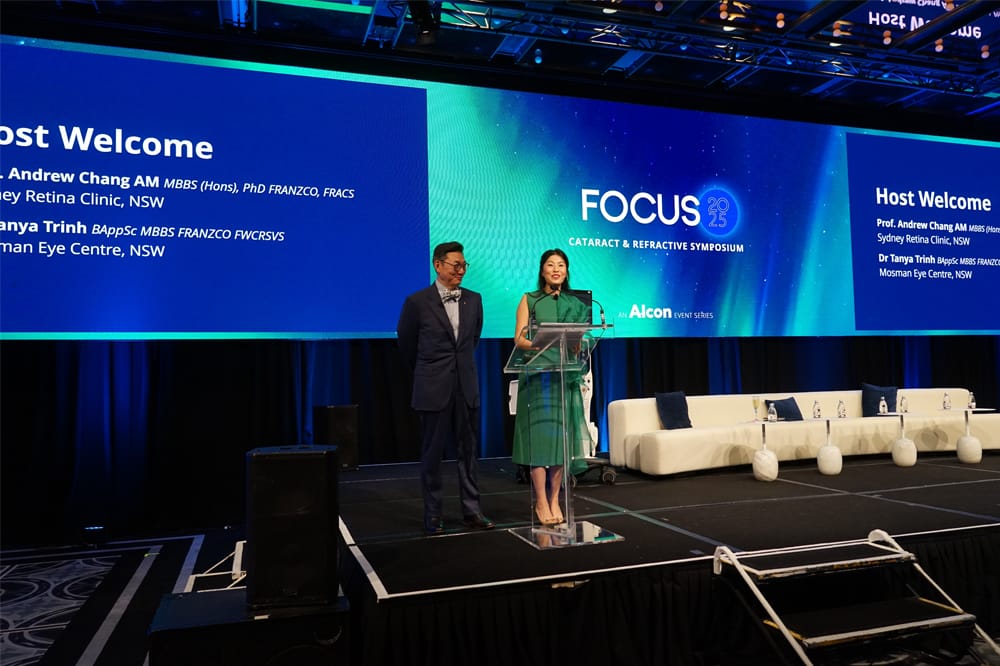
An educational dinner event during the Alcon Focus Symposium provided ophthalmologists with the opportunity to hear all about the evolution of, and early experience with, the Unity VCS and CS surgical platform.
The symposium was part of a two day Alcon Focus event, held in Sydney in March. The moderators were Professor Andrew Chang AM and Dr Tanya Trinh (both surgeons at the Sydney Eye Hospital), who engaged the audience while educating surgeons on technologic innovations and reinforcing their significance for patients.
Seba Leoni, President International Surgical of Alcon, spoke about Australia’s role as the first international market to have Unity VCS available, describing it as “technology that will be with us for years to come and redefine cataract and vitreoretinal surgery around the world”.
Underscoring Alcon’s commitment to innovation, he said the company invests nearly a billion dollars annually in eye care research and development.
Pioneering Four-Dimensional Phaco Technology
Dr Ivo Ferreira, joining virtually from Mexico in the early hours of his morning, shared his expertise on the Unity VCS system’s groundbreaking fluidics and four-dimensional (4D) phaco technology.1,7 With infectious enthusiasm, he described his journey working alongside the research and development team to test the system in extreme conditions.
“Our Unity came as a revolution,” Dr Ferreira declared, detailing how the system’s intelligent hydraulics outperform existing technologies with sensors positioned closer to the surgical site, enabling faster responses to changes. He said the system’s 4D phaco technology creates a pattern that increases the emulsification area while optimising timing for maximum efficiency.
Dr Ferreira said the system delivers results “two times faster with 41% less energy and 48% less CDE (cumulative dissipated energy)”, and said that once a surgeon experiences Unity, “there’s no way back”.^3
Transforming Surgical Efficiency and Safety
Associate Professor Smita Agarwal (NSW) – a self-confessed enthusiastic adopter of innovative technologies – presented on the “new kid on the block”, tracing the evolution from Charles Kelman’s introduction of phacoemulsification in 1967 to the current Unity VCS system. She also spoke about the suite’s phaco technology stating that along with improvements in speed, energy usage, and CDE, the phaco handpiece with built-in temperature sensors regulate ultrasonic power to prevent corneal burns.1,3,7
She said the Unity VCS promises improved workflow efficiency with its intuitive graphic user interface, 25% faster system setup, and streamlined inventory management.2
For day surgeries, the combined functionality for both cataract and vitreoretinal procedures means nurses need only learn one system, reducing theatre turnover time significantly.2†,††,‡,§
“Who would not want it?” Assoc Prof Agarwal asked enthusiastically. “I loved it when I tried it.”
Unifying Anterior and Posterior Segment Surgery
Australian vitreoretinal surgeons were chosen to conduct the first in human trial of the Unity VCS System and new ancillary instrumentation in April 2024. Prof Chang, a trial investigator performing the first surgery in the world with this new technology, highlighted new pump technology, which forms the fundamental basis of efficiency and safety, in both vitreoretinal and cataract surgery. He shared surgical cases and video from the clinical trial demonstrating how technological innovations in fluidics, control of intraocular pressure, including 27 gauge cutter technology, illumination, and instrumentation have addressed the unmet need for vitreoretinal surgeons.
A concluding panel discussion featuring Prof Chang, Dr Trinh, Assoc Prof Agarwal, and Mr Leoni explored the “unification of the anterior and posterior segment” that the Unity VCS platform creates for future development.
Dr Trinh discussed the implications for ‘middle segment surgery’, where collaboration between anterior and posterior segment specialists can improve patient outcomes.
Patients with complex conditions, such as dislocated intraocular lenses combined with anterior segment trauma or disease, require specific instrumentation and specialised skills of corneal, cataract, anterior segment reconstruction, refractive and retinal surgery – and where surgery can be safely combined, is better for the patient. “This is really about patient-driven outcomes and also having a higher standard of safety,” she noted, suggesting Alcon could lead in establishing standards and training for this emerging surgical special interest.
The panel also discussed the system’s physiological intraocular pressure (IOP) settings, with Assoc Prof Agarwal suggesting that “logical IOP is that IOP which is good for that person’s eye,” reminding surgeons of the principle to “do no harm” by reducing IOP where possible.
Mr Leoni shared the commitment of Alcon to continue development of the Unity platform and the panel discussed the importance of surgeon and industry collaboration and partnerships. The ultimate aim is to empower surgeons to perform more efficient and safer surgery in more patients with complex eye conditions, and to achieve better outcomes.
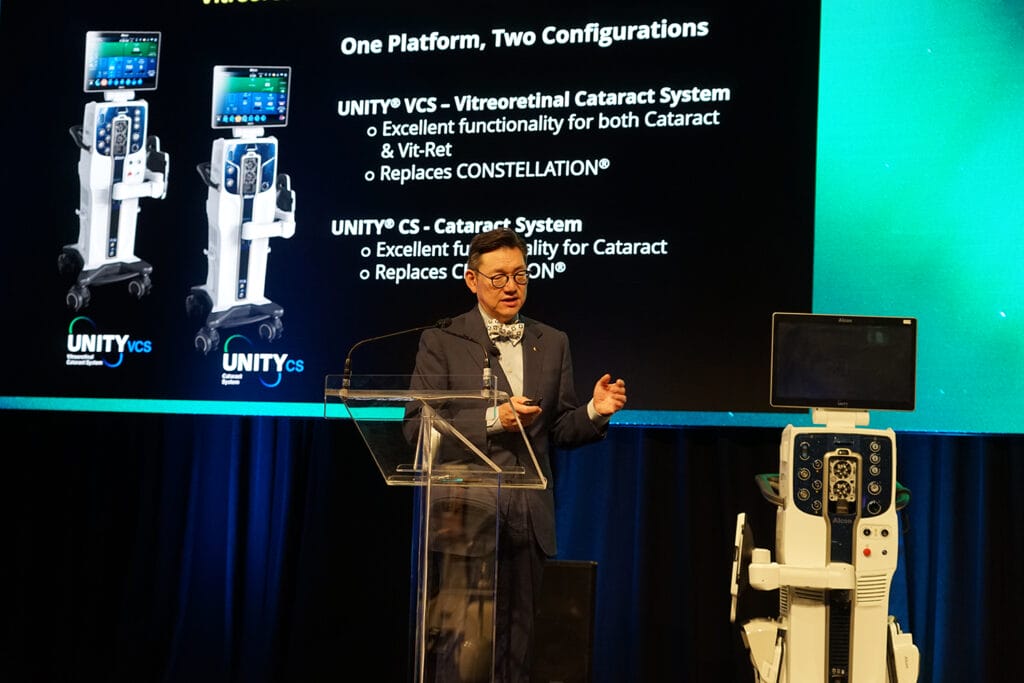
Further reading: Alcon’s Vision Ecosystem: Focussed on Surgical Solutions and Alcon Focus 2025: Unifying Anterior and Posterior Segment Surgery.
References
- Unity VCS and CS user manual.
- Alcon data on file 2024. REF-25374.
- Alcon data on file 2024. REF-24379.
- Alcon data on file 2024. REF-24644.
- Irannejad A, Tambat S, Abulon DJK. Retropulsion and mass flow of 27-gauge vitrectomy probes: Comparison of dual-blade/flattipped probes and single blade/beveled probes. 2021. Poster presentation.
- Alcon data on file 2024. REF-24576
- Unity phaco handpiece directions for use.
* Compared to Constellation Hypervit 20k vitrectomy probe.
** Versus Alcon’s Non-Dynamic Stiffener 27+ technology.
^ Based on N=10 HPs, artificial cataract lens IOP 55 mmhg vacuum of 450 mmHg.
† Compared to Constellation Vision System.
†† For posterior segment surgeries/posterior cassette pack.
‡ (P < 0.001).
§ ~1.5 minutes faster.