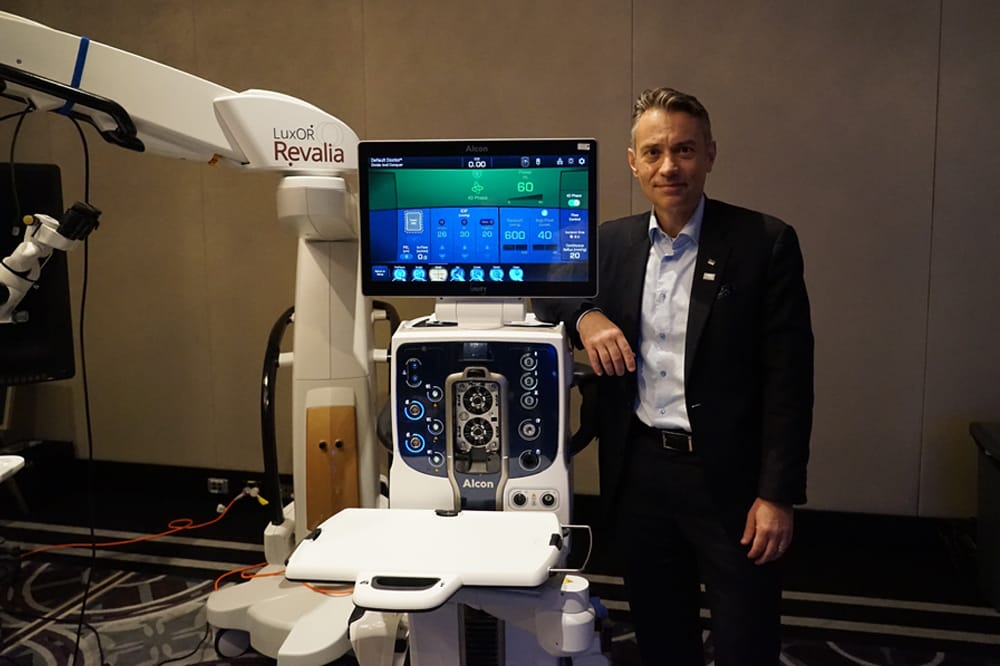
Faced with growing elderly populations around the world requiring cataract and vitreoretinal surgeries, limited growth in surgeon capacity, and declining specialised staff, ophthalmic manufacturers are pushing the boundaries of engineering to develop innovative technologies. Alcon is one of those companies.
With a significant team of engineers, the global leader is focussed on addressing core challenges facing ophthalmic surgeons by developing technologies that are easier, faster, more efficient, and safer.
At Alcon’s recent Focus meeting in Sydney, mivision sat down with Seba Leoni, President International Surgical of Alcon, who was in town to officially launch Alcon’s Unity Vitreoretinal Cataract System (VCS) and Unity Cataract System (CS), the latest additions to the Alcon Vision Suite.
Mr Leoni told mivision that “the Alcon Vision Suite is terminology we use to describe the ecosystem of products, services, and digital solutions that ultimately, we put into practice to help our customers power their practice”.
He said the suite represents a significant shift in eye care’s approach to technology integration, combining products, services, and digital solutions to help practitioners power their practices while prioritising patient outcomes. This approach creates what he described as a “multiplier effect” – the more Alcon devices that are integrated into a practice, the greater the efficiency and value delivered.
“Customers very much appreciate the Vision Suite because it combines legacy technologies along with innovation, and connects them,” he explained.
Furthermore, this “open ecosystem” is capable of connecting devices from other suppliers “to help surgeons drive their practice in the way that makes sense for them, and at their own pace”.
Digital Connectivity
The Alcon Vision Suite’s digital connectivity extends beyond the operating room to provide secure data transfer to clinical practices, which not only creates efficiencies, but also improves patient safety.
“Digital really comes down to connectivity in terms of connecting instrumentation within the operating room, but also from the clinic to the operating room,” Mr Leoni explained. “It minimises the risk for things like transcription error, which can ultimately lead to the wrong eye surgery or suboptimal outcomes because of a plan not being transcribed appropriately.”
For surgeons working across multiple facilities, this connectivity offers substantial benefits. “Having the ability to set your parameters on your phaco machine and by the touch of a button, having those parameters uploaded to all your phaco settings under your own personalised login, can be hugely powerful,” Mr Leoni observed.
Staff Training and Retention
A significant advantage of the integrated ecosystem approach is simplifying staff training in an environment where practices face increasing turnover rates.
“We’ve seen around the world a higher turnover rate of staff members and, of course, staff training is critical,” Mr Leoni said. “The ability for us to facilitate (education) and bring more intuitiveness into the design of the technology (is essential).”
He compared the experience to consumer technology. “Think about in our daily life when the iPad was introduced; for those of us that use the iPhone, it was kind of a seamless experience to transition from the iPhone to the iPad. And that’s the kind of approach that we’re taking with our future technologies.”
Unity VCS: Setting New Benchmarks
The latest addition to Alcon’s Vision Suite – the new Unity VCS – was recently included in the Australian Register of Therapeutic Goods. The system represents a significant advancement, combining cataract and vitreoretinal capabilities in a single console.1
“Unity VCS is our next generation platform for vitreoretinal and cataract surgery. Australia and Japan were the first markets outside of the US, to have the product available,” Mr Leoni said.
He said the Unity VCS “sets a new benchmark in the surgical experience across both cataract and vitreoretinal surgery”, by creating efficiencies for nurses and staff that enable “faster turnover time and faster calibration ahead of the next case”.2
The technology delivers impressive performance improvements. For cataract procedures, the system can take “half the time with almost half the energy going into the eye”.^3 For vitreoretinal surgery, surgeons are seeing “with 50% faster vitrector cutting speeds”*1,4,5 using 27 gauge technology that feels like 25 gauge technology from a stiffness and control point of view”.**6
Development Process
Mr Leoni has been involved with the Unity VCS since 2017, when it was “just this features and benefits set on a piece of paper”, and he said its development has involved deep engagement with eye care professionals.
“At Alcon, the way we drive innovation is by seeing the needs of the patients through the eyes of the surgeons that take care of them,” he explained.
He said continuous feedback from surgeons worldwide has resulted in multiple iterations. Even just weeks before launch, Alcon continued to optimise settings and approaches for different surgical techniques.
The Unity ecosystem will continue to expand, with more technologies under the Unity umbrella joining the VCS and CS.
Future Directions
Looking ahead, Mr Leoni outlined Alcon’s vision focussed on what he calls “the three Es: emmetropia, efficiency, and economics”, each playing a crucial role in delivering better outcomes for surgeons and their practices.
“From an emmetropia point of view, we want to develop technologies that make it easier for customers and staff members to deliver great patient outcomes,” Mr Leoni explained.
He said Alcon’s focus on efficiency addresses the operational challenges practices face today, taking multiple forms, beginning with multi-functional technologies.
For example, with the new Unity VCS he said, “single footprint technology can do cataract and vitreoretinal. That was not the case before”.
Other efficiency drivers include streamlined staff training, faster intraoperative procedures “while maintaining a high bar of safety”, and quicker turnover between cases. As Mr Leoni noted, this “enables practices to do one or two more cases in a surgical session, which can be critical in maximising the facility’s uptime”.
Interoperability also plays a key role in efficiency. The ability to “move data from one machine to the next” and enable connectivity for “preventative maintenance and remote service” helps minimise downtime and ensure smoother operations.
The third E (economics) focusses on the business realities facing surgical practices.
“In a world where time is money,” as Mr Leoni puts it, the economic benefits of Alcon’s ecosystem approach are substantial.
Multiple functionalities in a single system reduce capital expenditure and ongoing maintenance costs. The efficiency gains translate directly to revenue opportunities: “The ability to improve efficiency within the individual technologies that we talked about earlier, enable faster procedures. There’s additional revenue that the centres can drive, just by being able to do one or two more cases in a surgical session.”
For practices struggling with staff retention and rising costs, Mr Leonie said these economic benefits can make a significant difference to profitability while still prioritising patient care.
Further reading: Alcon Unity VCS Revealed in Australia and Alcon Focus 2025: Unifying Anterior and Posterior Segment Surgery.
References
- Unity VCS and CS user manual.
- Alcon data on file 2024. REF-25374.
- Alcon data on file 2024. REF-24379.
- Alcon data on file 2024. REF-24644.
- Irannejad A, Tambat S, Abulon DJK. Retropulsion and mass flow of 27-gauge vitrectomy probes: Comparison of dual-blade/flattipped probes and single blade/beveled probes. 2021. Poster presentation.
- Alcon data on file 2024. REF-24576
- Unity phaco handpiece directions for use.
* Compared to Constellation Hypervit 20k vitrectomy probe.
** Versus Alcon’s Non-Dynamic Stiffener 27+ technology.
^ Based on N=10 HPs, artificial cataract lens IOP 55 mmhg vacuum of 450 mmHg.
† Compared to Constellation Vision System.
†† For posterior segment surgeries/posterior cassette pack.
‡ (P < 0.001).
§ ~1.5 minutes faster.