


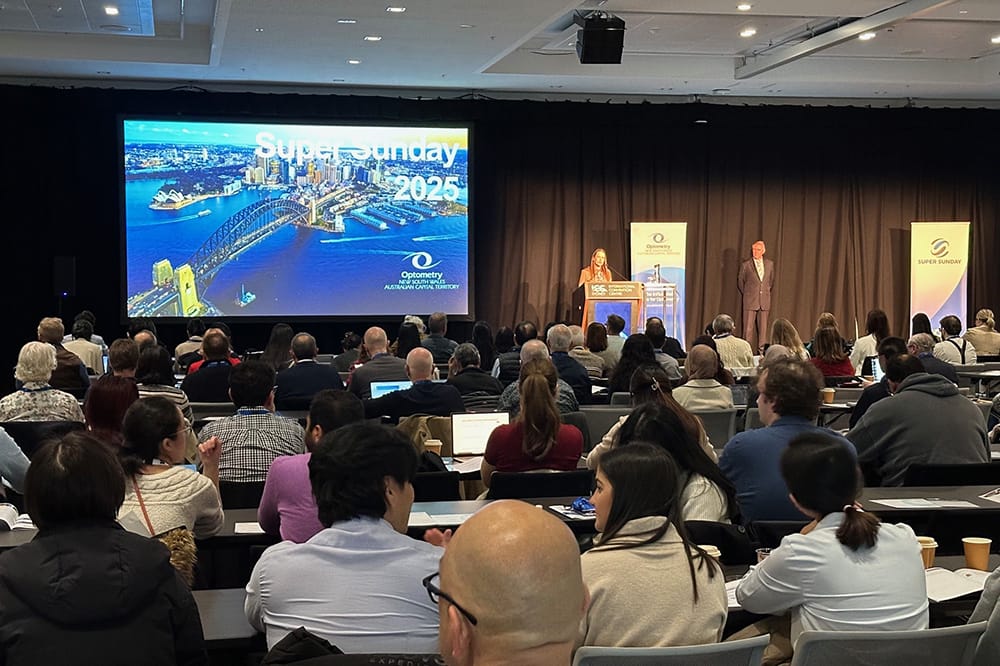
Clinical optometrist Heidi Hunter at the opening of Optometry NSW/ACT's Super Sunday.
Energy, insight, and innovation were on full display at Super Sunday 2025. Held at Sydney’s iconic International Convention Centre in Darling Harbour and organised by Optometry NSW/ACT, this year’s event marked the 13th edition of the much-loved conference – and it didn’t disappoint.
With a packed programme of sharp clinical content, big-picture thinking, and an electric trade fair powered by the Optical Distributors and Manufacturers Association (ODMA), Super Sunday brought together the brightest minds in optometry. From new grads to seasoned practitioners, the full day conference delivered fresh ideas, practical pearls, and a strong sense of connection across the profession.
What’s New in Optometry?
Opening the show, Dr Jack Phu, honorary lecturer at the University of New South Wales, delivered an update across genetics, systemic disease associations, diagnostics, and the evolving role of artificial intelligence in the context of glaucoma. He began by unpacking the growing conversation around genetics in glaucoma, reminding attendees that while family history remains a practical proxy for genetic risk, commercially available genetic testing options are emerging. However, he cautioned that these tools demand specialised training to interpret results meaningfully in clinical settings.
Dr Phu provided a detailed update on visual field testing, comparing traditional and emerging protocols. When comparing 24-2 and 24-2C tests, he noted that global metrics such as mean deviation showed minimal differences. The additional central points tested with 24-2C allows for a slight improvement in structure-function agreement within the central field. In contrast, the 10-2 test proved more effective at detecting central visual field defects compared to 24-2C and demonstrated stronger structure-function concordance.
Dr Phu emphasised the clinical benefits of ‘front-loading’ visual fields, noting how performing two or more visual field tests within a shorter time frame can lead to faster glaucoma progression detection
Dr Phu emphasised the clinical benefits of ‘front-loading’ visual fields, noting how performing two or more visual field tests within a shorter time frame can lead to faster glaucoma progression detection. He also cautioned against overreliance on reliability measures such as gaze tracker, or interpreting reliability indices such as false positives in isolation. The value of trained technician oversight to ensure test reliability was stressed.
Looking forward, Dr Phu explored the emerging role of artificial intelligence (AI) in visual field interpretation and optical coherence tomography (OCT) analysis. While human interpretation can be variable, one potential advantage of AI tools is greater consistency compared to clinicians. Balancing its potential benefits and enduring weaknesses, AI remains a supportive tool, but does not replace clinicians in differential diagnosis and ongoing monitoring of glaucoma.
Myopia Mastery: Latest Insights
Myopia Profile’s Dr Kate Gifford took the stage with an insightful presentation on the evolving landscape of myopia management, highlighting both emerging treatments and key clinical considerations for optometrists.
A particularly interesting topic was the growing interest in repeated low-level red-light therapy (RLRL), a novel approach involving the use of 650 nm laser diodes viewed for three minutes, twice daily, five days a week. Originally developed in China for amblyopia treatment, RLRL is now being explored as an alternative and adjunct treatment for managing myopia. While early studies have shown promising outcomes, including axial length shortening in some patients, Dr Gifford addressed safety concerns, referencing a reversible case of retinal damage reported in the literature. Although initially classified as Class 1 lasers, all RLRL devices, with the exception of Eyerising’s RLRL device, have since been reclassified as Class III in China, reflecting high risk from both an efficacy and safety perspective. Eyerising’s RLRL device has received Class IIa/Class B regulatory approval internationally.
Dr Gifford also delved into the prospect of delaying or preventing myopia onset, noting how even a one-year delay in onset could reduce eventual myopic progression of approximately 0.75D in Asian children and 0.50D in western populations equivalent to the benefit of two to three years of active myopia control treatment.
The risk factors for pre-myopia were another key focus, with discussion of risk factors including family history, binocular vision anomalies, and inadequate hyperopic reserves. Insights into adult myopia progression were also presented. Dr Gifford interestingly shared that 15% of individuals develop myopia in their 20s; 20% experience progression of at least -1.00D; and 40% progress by -0.50D or more, emphasising the importance of ongoing monitoring into adulthood.
Finally, she highlighted the need for retinal health monitoring in high myopes, particularly in young patients. A study from Vietnam revealed that among young individuals with high myopia, 43% had peripheral retinal lesions and 66% exhibited central retinal changes.
A particularly interesting topic was the growing interest in repeated low-level red-light therapy
Be More Than OK with OK
Drawing on her wealth of experience, Celia Bloxsom, the long-serving Secretary of the Orthokeratology Society of Oceania since 2003, provided valuable clinical pearls for navigating orthokeratology (OK) lens fittings.
A key takeaway was the value of trial fitting to accurately assess patient suitability, lens fit, centration, and ocular surface interaction. Equally important is obtaining high-quality baseline corneal topographies that entail accurate horizontal visible iris diameter and vertical visible iris diameter to enhance fitting and follow-up outcomes.
When it comes to clinical decision making and troubleshooting, Ms Bloxsom advised that poor centration should be addressed early, as this does not get better with time. She also discouraged early prescription changes, recommending clinicians wait at least three weeks before reassessing manifest refraction post-fitting to allow treatment effects to stabilise.
In terms of managing treatment dynamics, Ms Bloxsom explained that treatment wear-off can be rapid in children, who tend to mould and regress faster, meaning consistent nightly wear is crucial, particularly in myopia control cases. To manage over-treatment or regression, strategies that she suggested included using old glasses, low-powered soft contact lenses, or incorporating reduced-power spectacles into the OK package. However, she cautioned that soft lenses require additional patient education and may increase risk of non-compliance.
A key takeaway was the value of trial fitting to accurately assess patient suitability, lens fit, centration, and ocular surface interaction
Interactive Cases: Myopia and AMD
In her second talk, Dr Gifford returned to the stage to lead an interactive session focussed on complex cases in myopia management. She spoke about how progressive astigmatism in the context of myopia is abnormal, and such changes warrant careful monitoring and possible investigation. Dr Gifford then discussed evidence supporting the management of anisometropic myopia, and offered advice on how different myopia control options may be applicable for such cases.
Certain binocular vision anomalies are associated with myopia development and/or progression, including accommodative lag, high accommodative convergence to accommodation ratio, and intermittent exotropia. These conditions may influence the choice of myopia control strategy and underline the importance of a thorough binocular vision assessment in myopia workups.
For ongoing care, six monthly reviews are recommended by the International Myopia Institute. These follow-ups are key to assessing whether the treatment is effective and for monitoring for refractive changes. Dr Gifford noted that a -0.25D shift is often not concerning and should warrant reassurance for the patient, while a -0.50D change might necessitate a prescription update. However, she advised not to abandon treatment too quickly, as seasonal variations can also account for refractive fluctuations.
AMD: The Optometrist’s Role In 2025
Experienced retinal specialist Dr Michael Chilov (Sydney) then took to the stage, shifting the focus from myopia in younger patients to age-related eye concerns in older patients. His talk centred on the optometrist’s role in managing age-related macular degeneration (AMD).
Dr Chilov started by revising current approaches to managing early, intermediate and advanced AMD, before sharing promising developments on the horizon. One of the most significant is photobiomodulation (PBM), a treatment authorised by the United States Food and Drug Administration as of 2025. This therapy uses a device that delivers multi-wavelength light to the retina to stimulate mitochondrial function, aiming to slow degeneration. It is indicated for early and intermediate AMD, as well as non-centre-involving geographic atrophy (GA), with patients undergoing nine treatments over three to five weeks every four months.
For patients with GA, new complement factor inhibitors have shown promise. Pegcetacoplan (Syfovre), approved in Australia by the Therapeutic Goods Administration (TGA) in January 2025, is now available for patients with GA secondary to AMD, particularly when the fovea is still intact but at risk. Trial data has shown this drug can slow the rate of GA progression. However, Dr Chilov cautioned that the treatments don’t reverse damage or improve vision.
In terms of diagnosis and monitoring, fundus autofluorescence (FAF) and OCT were highlighted as key tools. On FAF, areas of GA appear hypo-autofluorescent due to atrophic retinal pigment epithelium (RPE), and these can be quantified and monitored over time. On OCT, hypertransmission beneath the RPE associated with cRORA (complete RPE and outer retinal atrophy) corresponds to GA and is used to track its progression.
Dr Chilov concluded with practical advice for optometrists: after diagnosing GA, consider whether there is foveal involvement. If the fovea is not yet involved but central vision is threatened by lesion growth, referral for potential treatment should be considered. Referral is also indicated in any case where neovascular AMD is suspected.

Celia Bloxsom at Super Sunday.

Heidi Hunter opens the conference.

Dr Jack Phu speaking at Optometry NSW/ACT's Super Sunday.

Dr Kate Gifford from Myopia Profile.

Dr Michael Chilov.

Sallyanne Morrison, from Morrison’s Family Eyecare Centre in Dubbo, receiving the inaugural Christine Craigie Distinguished Service Award.

Sallyanne Morrison, from Morrison’s Family Eyecare Centre in Dubbo, receiving the inaugural Christine Craigie Distinguished Service Award.

Optometry NSW/ACT's Super Sunday.
How to be a Happier Practitioner
Next, was a panel discussion led by Audrey Molloy (Optometry NSW/ACT), featuring inspiring optometrists Joshua Clark (Alcon), Alison Abdullah (Sydney), Lindsay Moore (Centre for Eye Health), and Celia Bloxsom (Gold Coast) sharing personal insights on navigating the profession beyond traditional roles.
Ms Abdullah reflected on launching her boutique practice in Sydney after an unorthodox start working overseas. Working in ophthalmology abroad without formal local qualifications challenged her to adapt skills she later channelled into building her innovative business.
Mr Clark spoke about the broad scope of optometry, noting that the profession can extend beyond clinical practice to include work in hospitals, behavioural, and ophthalmology clinics, highlighting the flexibility and diversity optometry offers.
Ms Moore shared a personal anecdote, recalling being told at 17 that most people change careers three times. Initially sceptical, she came to embrace change, later completing a project management course that helped guide her transition into her current role.
Ms Bloxsom encouraged optometrists to view challenges as growth opportunities, reminding attendees that success often comes from stepping outside of one’s comfort zone.
Using Optometry for Good
Optometrist Marc Eskander (Sydney), known for his strong commitment to making healthcare more accessible, brought a deep sense of purpose to his presentation. His passion culminated in the co-founding of Eyes of Hope, a mobile optometry service dedicated to providing free, consistent, and compassionate care to people experiencing homelessness across NSW.
Mr Eskander highlighted the critical gap in stable, ongoing eye care for this vulnerable population. He spoke candidly about the complex barriers that patients face, including financial hardship, past trauma, mistrust of healthcare systems, and social stigma; factors that often prevent them from seeking help through traditional models of care.
Mr Eskander also reflected on the logistical hurdles involved in building a mobile clinic from scratch; from working out how to refrigerate eye drops on the road to designing a portable slit lamp setup that could function reliably in outreach settings.
Informed Consent and Follow Up
The panel discussion on best-practice informed consent and follow-up, led by Paula Katalinic, featured Andrew McKinnon, Ms Molloy, and Rebecca Tobias (all Optometry NSW/ACT), and offered an insightful case-based exploration of the legal and practical responsibilities optometrists face in everyday clinical care.
Key messages centred on the optometrist’s duty to make a reasonable effort to follow up, especially in high-risk cases. While lower-risk scenarios may not require the same intensity, maintaining thorough documentation remains essential across the board. Simple yet effective strategies, such as pre-booking follow-ups, verifying updated contact details, and ensuring accurate review intervals, were recommended to help streamline processes and avoid patients falling through the cracks. Emergency situations also require clear instructions, and a defined time frame should always be specified.
When it comes to informed consent, particularly for treatments such as OK or atropine, the panel underscored the importance of taking time to explain the therapy, answer questions, and document the conversation. Mr McKinnon also clarified legal considerations around age and consent, noting how under 14s require parental consent, however those over 16 generally have the capacity to consent independently.
With contact lens training, the panel concluded that instructional videos should serve only as an additional resource but shouldn’t substitute practical, hands-on teaching.
Christine Craigie Distinguished Service Award
The session continued with a heartfelt moment as Sallyanne Morrison, from Morrison’s Family Eyecare Centre in Dubbo, was named the recipient of the inaugural Christine Craigie Distinguished Service Award, created in honour of the late Christine Craigie, who left a lasting legacy through more than 25 years of service on the Board of Optometry NSW/ACT.
Ms Morrison’s dedication to optometry spans over three decades, delivering exceptional eye care to the Dubbo region and surrounding communities. Her impact extends beyond the clinic through her outreach work, mentorship of students and early-career optometrists, and her ongoing efforts to advance the scope of optometric care.
Management of Anterior Eye Conditions
The next session began with corneal, cataract, and refractive surgeon Dr Tanya Trinh (Sydney), who presented practical insights into post-graft management through an interactive case discussion. She outlined the typical suture removal timeline, noting its gradual nature, with the process starting earliest at nine months post-op. She also highlighted the usual regimen for steroid use, which includes gradual steroid tapering over a 12-month period to reduce rejection risk.
As per risk mitigation, it is critical that regular contact with patients should be maintained within the first 12 months, followed by six-monthly reviews. Dr Trinh said IOP control is paramount during reviews to detect steroid responders. She noted how steroid responders “can be fine for years before eliciting a response”.
Dr Trinh then reviewed signs of graft rejection highlighting key signs including conjunctival injection, keratic precipitates, corneal haze, oedema, Descemet’s membrane folds, and the appearance of a Khodadoust line.
Changes in topography can be attributed to corneal oedema, which causes stromal and epithelial distortion. Pachymetry readings may increase due to compromised endothelial function. This thickening can falsely elevate IOP readings, though true IOP rises should be managed cautiously.
Dr Trinh outlined several rejection risk factors, including early steroid taper, vascularised host beds, large grafts, trauma, infection, inflammation, vaccinations, and non-compliance. Loose sutures also pose both infection and rejection risks. She concluded by acknowledging the important role of optometrists in early detection, patient education, prompt treatment initiation, and timely referral.
Recurrent Corneal Erosions
Clinical optometrist Heidi Hunter (Newcastle) followed with an informative presentation on recurrent corneal erosions, a condition involving repeated breakdown of the corneal epithelium. She highlighted several indicators for bandage contact lens use, including recurrent corneal erosion (RCE), Thygeson’s superficial punctate keratitis, traumatic abrasions, non-healing ulcers, post-surgical wounds, bullous keratopathy, dry eye, and neuroprotection of the cornea.
Ms Hunter captivated the audience with a particularly interesting case involving a patient she managed, who presented with RCE and was initially well managed by a bandage contact lens. However, the clinical picture evolved rapidly, with infection scares, onset of secondary bullous keratopathy, and eventual corneal infection. Her storytelling and honest reflections on navigating uncertainty and clinical decision making left a strong impression, underscoring the critical importance of close monitoring for cases alike.
Clinical optometrist Heidi Hunter (Newcastle) followed with an informative presentation on recurrent corneal erosions
Therapeutic Treatment of Dry Eye
The final discussion of the day saw the return of Ms Bloxsom, who delivered an informative talk on the therapeutic treatment of dry eye disease.
Ms Bloxsom outlined the updated Tear Film and Ocular Surface Society Dry Eye Workshop (DEWS III) framework, which breaks down dry eye into three key domains: the tear film, the lids, and the ocular surface. She highlighted the importance of identifying the clinically relevant drivers in each individual case to guide targeted management.
Ms Bloxsom also revisited DEWS II recommendations, which advise using one symptom survey, such as the Ocular Surface Disease Index (OSDI) and at least three diagnostic tests, like non-invasive tear break-up time, tear osmolarity, and ocular surface staining. Importantly, she noted that not all tests need to be performed in practice, and only one positive test is required to make a diagnosis.
For treatment, Ms Bloxsom discussed cyclosporine-based therapies, such as Ikervis 0.1% and Cequa 0.09%, which offer anti-inflammatory benefits for patients with moderate to severe disease that have not responded well to more traditional treatment options.
A Day to Remember
As the sun set on Optometry NSW/ACT’s Super Sunday 2025, it was clear the event had once again delivered on its promise of bringing the optometry community together for a day of learning, connection, and inspiration. From deep dives into clinical cases to stories of leadership and service, every session sparked valuable takeaways.
Dr Tommy Tran is a therapeutically endorsed optometrist who practises at Eyecare Network in Canley Heights, Sydney. Graduating from University of New South Wales with a Bachelor of Vision Science and Master of Clinical Optometry with distinction, he completed his preceptorship at the Hong Kong Polytechnic University, and has volunteered with the Australian Health and Humanitarian Aid.
Dr Tran was the recipient of the 2024 mivision Prize in recognition of excellence in social engagement and advocacy of promoting eyecare to the community.


