


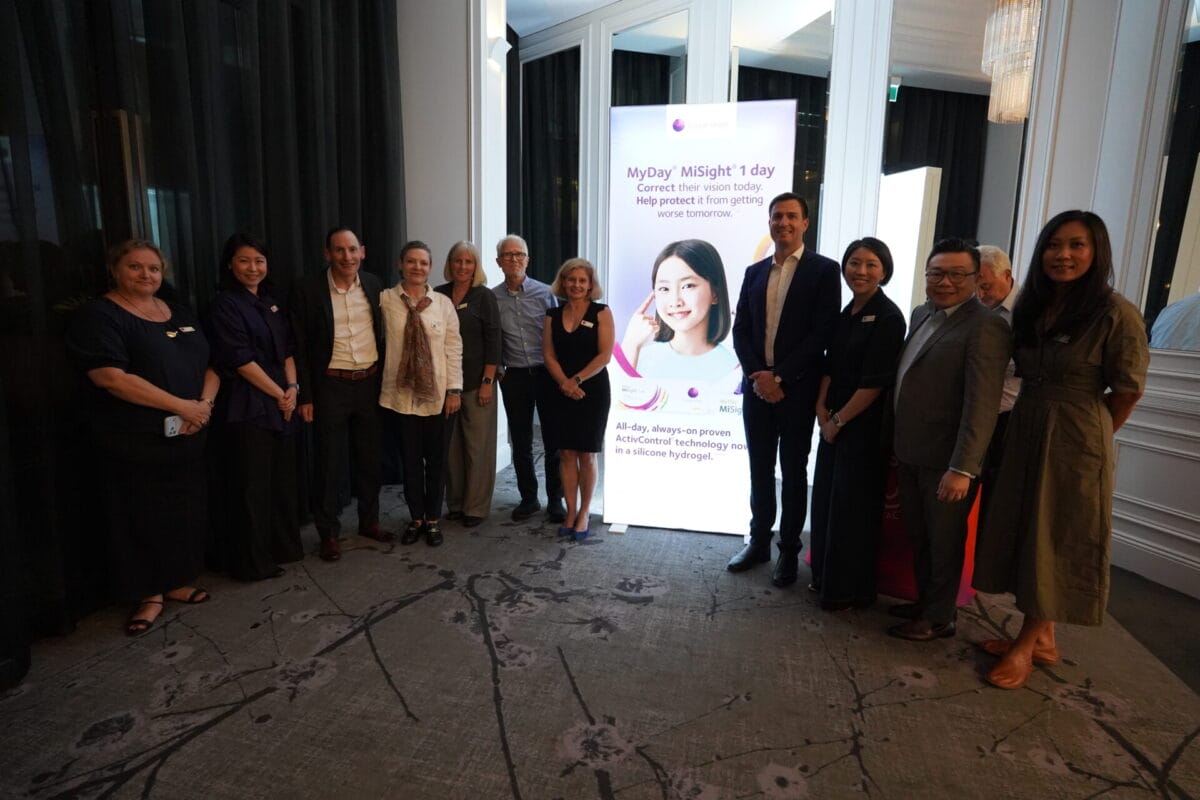
A fascinating evening of presentations, hosted by CooperVision, has provided clinicians with new strategies to help manage the rising incidence of myopia.
Joe Tanner Head of Professional Affairs for ANZ, said that beyond visual acuity, myopia management is ultimately about “managing and preserving retinal health”.
Optometrists, as primary eye care providers, have the critical responsibility of convincing myopic children, their parents, and carers of the need to manage the disease, explaining options to slow progression, and the consequences of inaction.
One option for management has been CooperVision’s MiSight® 1 day contact lens, which now has seven years of evidence to support its success in significantly slowing axial elongation.* Now CooperVision has launched its next iteration of the MiSight 1 day lens – MyDay MiSight 1day – which combines the ActivControl Technology of MiSight 1 day with the advanced silicone hydrogel material of MyDay to provide greater oxygen transmissibility.†,‡,1 Additionally, it has a built-in UV inhibitor to help protect the cornea and crystalline lens from harmful UV radiation.§
Dr Bradley reported that extensive testing had confirmed the lenses’ identical optical performance.
Managing Complex Conversations
Of course, technology is only part of the complex myopia management equation. Communicating with myopia patients, their carers, and parents about the need for long-term treatment can be equally challenging, especially for those with no knowledge of the disease.
At a roadshow to launch CooperVision’s new contact lens in Sydney, a leading medical communicator informed the audience about contemporary communication strategies in healthcare that give the patient (and in the case of myopia the parent/carer) full involvement through a process of shared decision making.
Noting that this is not an option for emergencies, they said “shared decision making” overrides the paternalistic approach of the past, recognising that as well as the health care professional (HCP) being a topic expert, the person in the room is an expert in their own right – they have values, expectations, and capacity constraints that must be considered. Rather than diagnosing and directing treatment (as per a paternalistic approach), shared decision making requires the HCP to articulate the diagnosis and “put the options on a platter”, setting out all the treatment options with the pros and cons for each, and then allowing the patient to decide which path forward they prefer.
The speaker said that, on occasion, a patient will choose to go with the HCP’s least preferred path. However, “the win is to get the patient back”. Giving the patient time to research (with accurate information) and consider their options and allowing them control over their treatment regimen will ensure greater compliance and, in the end, improved outcomes.
The speaker recommended optometrists refer to information on patient advocacy developed by the Australian Commission on Safety and Quality in Healthcare for further information (visit: safetyandquality.gov.au/our-work/partnering-consumers/shared-decision-making).
Understanding the Technology
Dr Arthur Bradley from CooperVision’s Global Research and Development team, who is based in the United States, spoke about the company’s approach to designing, developing, and clinically testing CooperVision’s myopia control contact lenses.
He explained the clinical trials undertaken to support MiSight 1 day lenses, stressing the importance of randomised double-masked approaches to avoid bias, and models of myopic and emmetropic eye growth to assess efficacy over time.
He then explained comparative testing undertaken to prove the new MyDay MiSight 1 day would deliver the same efficacy as the MiSight 1 day lens while further enhancing corneal health.
Dr Bradley reported that extensive testing had confirmed the lenses’ identical optical performance.2 Power profile measurements showed the lenses were essentially the same.2 On-eye positioning studies using ocular aberrometers demonstrated that both lenses positioned identically on children’s eyes.2 Quantitative analysis showed both lenses delivered the same proportion of myopic defocus across the eye’s entrance pupil.2
He described visual acuity results as “exceptional”, with mean logMAR acuity of -0.15 (approximately 20/15), demonstrating that children achieved excellent vision with the new lens.◊,2 Subjective vision scores were very high (87–89 out of 100), nearly matching single vision lens performance.¶,2 Furthermore, performance was consistent across all testing environments.
When wearing time equals treatment time, the longer a patient can keep their contact lens on eye, the better the efficacy.** Dr Bradley reported that children wore their new MyDay MiSight 1day lenses for an average of 12 hours per day, almost seven days per week.††,2,3,4 Comfort scores were extremely high (86–90 out of 100) for both lenses. Most importantly, 100% of children reported being happy with MyDay MiSight 1 day lenses, with the majority being “very happy” and handling was rated as very easy or easy by most children.‡‡,2
Mr Tanner concluded the evening, encouraging optometrists to begin switching their patients from MiSight 1 day to MyDay MiSight 1 day as they return for routine aftercare. While both lenses will continue to be available, he said many patients who had trialled the lenses had noted better handling, making the switch a positive experience.§§,2


*MyDay MiSight 1 day contact lenses use the same ActivControl Technology as the original MiSight 1 day.
†Proven to slow myopia progression in children compared to a single-vision 1-day lens over a three-year period.
‡ Based on manufacturers published data. MyDay MiSight 1 day has Dk/t of 100. Compared to the original MiSight 1 day (Dk/t 28), NaturalVue Multifocal 1 Day (Dk/t 25)
- Warning: UV-absorbing contact lenses are not substitutes for protective UV-absorbing eyewear, such as UV-absorbing goggles or sunglasses, because they do not completely cover the eye and surrounding area. Patients should continue to use UV-absorbing eyewear as directed.
◊ In a clinical study, VA (LogMAR) >6/6 (20/20) for both study visits (dispense and 1 week).
¶ 94% of children reporting overall vision satisfaction as either very happy (31%), happy (50%), or slightly happy (13%) after 1 week of daily wear.
** For example, CooperVision MiSight 1 day contact lenses are recommended to be worn 10+ hours per day, 6 day a week; Essilor Stellest lenses are 12+ hours per day, 7 days a week.]
†† In clinical study, mean weekday wear time increased from 12.8 hours/day at 6 months to 13.9 hours/day at 6 years with a mean of >6.5 days/week for MiSight 1 day, which shares the same ActivControl Technology with MyDay MiSight 1 day.
‡‡ Clinical study participants at the 1-week visit. 38% rated very happy, 53% rated happy, 9% rated slightly happy with overall comfort satisfaction.
- § 94% vs. 81% after 1 week of daily wear, p=NS.
References
- Chamberlain P et al A 3-year Randomized Clinical Trial of MiSight Lenses for Myopia Control. OVS 2019;96:556-567.
- CVI data on file 2025. Prospective, 1-week, double-masked, randomised, bilateral crossover study with MiSight 1 day and MyDay MiSight 1 day. N=32 subjects aged 8-18 years.
- Woods J et al. Ocular health of children wearing daily disposable contact lenses over a 6-year period. CLAE 2021 Aug;44(4):101391.
- CVI data on file 2025.


