


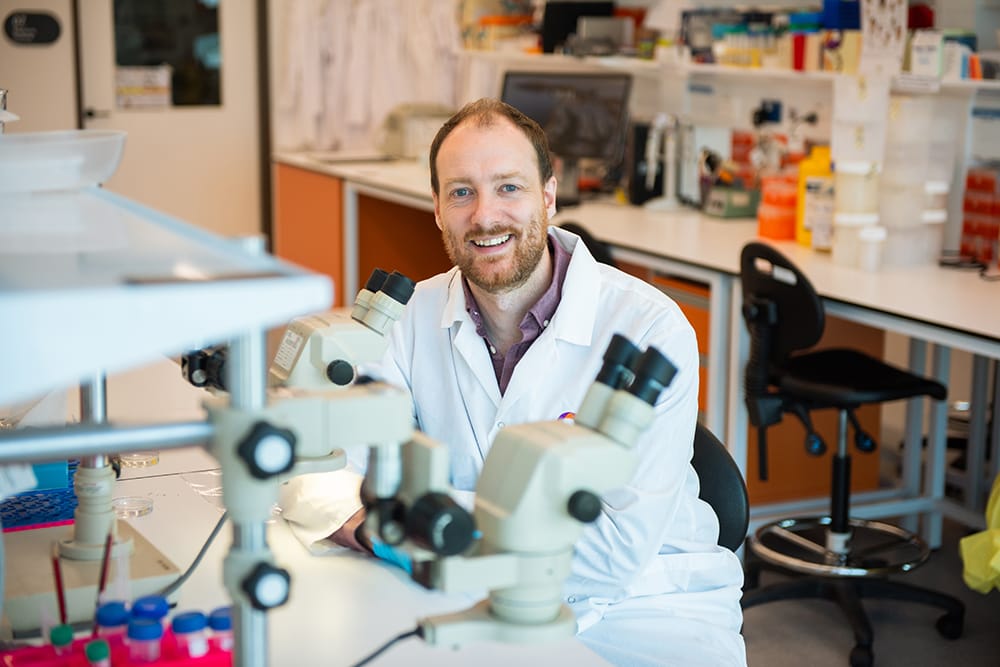
Leading international glaucoma researcher Professor Pete Williams has joined the Centre for Eye Research Australia (CERA), to lead its new Neuroprotection and Repair Research program.
With a career spanning the United Kingdom, the United States, Sweden, and Singapore, Prof Williams has joined CERA to continue his work, which aims to find better ways for people with glaucoma to keep their sight.
While current treatments that include pressure-lowering eye drops, implants, and surgeries are effective ways to slow vision loss for many people, they don’t work for everyone and aren’t addressing the root cause of the condition.
Prof Williams said using eye drops to reduce intraocular pressure reduces the risk of retinal ganglion cells dying, but this alone isn’t enough to prevent cell death and vision loss.
“Retinal ganglion cells in the eye – the cells that are damaged in glaucoma – are like an old motorcycle trying to climb a hill,” Prof Williams said.
“And all the treatments we’re trying in the clinic are aiming to get that motorcycle over the hill.
Retinal ganglion cells in the eye – the cells that are damaged in glaucoma – are like an old motorcycle trying to climb a hill… and all the treatments we’re trying in the clinic are aiming to get that motorcycle over the hill.
“Surgical implants are like paving a smooth road for the motorcycle to ride on, reducing eye pressure is like knocking down the hill, and genomics is trying to understand exactly why the hill is there in the first place.
“But the problem is that even with all this help, a broken motorcycle at the bottom of the hill can go nowhere regardless of the road surface ahead.”1
Promising Future
Professor Williams’ research career has focused on how to target energy metabolism in retinal ganglion cells to prevent their deaths in several neurodegenerative diseases, including glaucoma. Before moving to Australia, his research had already yielded significant results.
Together with Research Fellow Dr Flora Hui, who has been leading the work at CERA, he has been investigating whether nicotinamide – a form of vitamin B3 – provided alongside current glaucoma treatments can support nerve cell function in the eye.
“I think we’re at a point in ophthalmology research where everything is going to start progressing really quickly,” Prof Williams said.
“I often describe ophthalmology research as being 10 years behind cancer and Alzheimer’s research.
He said those conditions were transformed 10 years ago, and glaucoma research was on the precipice.
“In the next 15 years, I think we will have clinical trials for the first protective gene therapies. In 15 to 20 years, I think we’re going to be looking realistically at stem cell replacement therapies and regeneration,” Prof Williams said.
Reference
- Centre for Eye Research. Saving Our Cells (online news) available at: cera.org.au/saving-our-cells/ [accessed Feb 2026].


