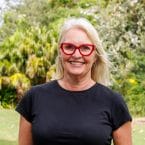
Hunter Valley optometrist Julie Purdie has found an unexpected harmony between clinical practice and creative expression, fusing her lifelong love of art with her career in vision science.
mivision Editor Melanie Kell sat down with Ms Purdie to talk about the intersection of vision science and art, and how almost three decades in clinical optometry have shaped the way she sees – and paints – the Australian landscape, while also inspiring a growing practice in conceptual photography.
Julie Purdie has loved art from a young age. As a child, she was always drawing, painting, taking photographs, and making things, and she studied art through to Year 12, alongside straight maths and science.
However, the idea of becoming a professional artist was not something that crossed her mind. “I grew up on a farm on the Darling Downs in Queensland, and my father was a very practical man. ‘No, you can’t be an artist,’ he told me. ‘That’s not a career’. So off I went to Brisbane to study optometry.”
Since graduating in 1997, Ms Purdie’s career has taken her through some very different landscapes, all of which have, perhaps subconsciously, continued to inspire her creativity.
“I spent a few years in Toowoomba working with an ophthalmologist, which really took me away from the retail side of optometry and towards the clinical work I loved. Then it was on to Mount Isa – Toowoomba is lush and green, and Mount Isa is red dirt desert, so that was a very different experience. Now I’m in private practice, here in the Hunter Valley in New South Wales.”
I probably never really expected optometry to influence my art in the way it has more recently.
Despite her ongoing interest in creating art, Ms Purdie said that for many years she kept her two worlds separate – one a profession, the other a passion to pursue in her downtime – which, with full-time work, three school-aged children, and a husband, was limited.
But what she didn’t realise all along was the creeping influence of one on the other.
“I probably never really expected optometry to influence my art in the way it has more recently.”
The turning point was being named a finalist in the National Emerging Art Prize in 2024. “Through that, I met Amber Creswell Bell – a very prominent figure in the Australian art world – and she agreed to mentor me,” said Ms Purdie.
“She encouraged me to bring those two worlds together, and said, ‘You need to make a body of work with those ideas’.”
Ms Creswell Bell’s advice was the catalyst to becoming a professional artist.
Ms Purdie compiled a catalogue of her work and eventually began working with Will Kollmorgen, the program manager for the Michael Reid Southern Highlands gallery in New South Wales – an experience she described as “incredibly rewarding”.
“What I’ve particularly appreciated is the thoughtful way he engages with the ideas behind an artist’s work and allows the work itself to lead the conversation,” she said.
The resulting series, Sightlines, “brings together my love of the Australian landscape with what I’ve learnt through almost three decades of working with human vision”.
It is available to be viewed online, or in person at Michael Reid Southern Highlands gallery by enquiry.

A Memory Without a Place, 2026.

Where the Eye Rests, 2026.
It’s About the Experience of Seeing
Ms Purdie works across two different art forms – painting and photography. The photography is usually monochrome, whereas the paintings are quite colourful, but the ideas behind them are closely connected.
“My photography would probably be categorised as conceptual photography, which is why one piece was a finalist in the Mullins Conceptual Photography Prize last year,” she explained. “I guess you’d call me a contemporary landscape painter if you had to put a label on it, but I haven’t really come across anyone else using visual physiology to approach landscape painting in quite this way.”
She said both art practices are really answering the same question: how do we experience sight?
“Most people think the eye operates like a camera, but we know it’s a lot more nuanced than that. Colour and clarity and brightness all vary across the visual field – unlike a camera – and then there’s refractive error, ocular disease, systemic disease, all having an effect, plus that extra processing layer where our attention, memory, and emotions shape what we see.
“With my knowledge of those layers of vision science, I’m not particularly interested in depicting the world like a camera would. I really like bringing those layers of visual perception into my work, making it more about the experience of seeing rather than simply recording what is in front of us.”
In the Sightlines paintings, Ms Purdie uses shifts in colour, brightness, and detail to reflect that experience. “These are heightened where our attention rests, while the surrounding visual field becomes quieter and less resolved. I’m not trying to create a literal illustration of central and peripheral vision, but to use what I know about vision to create landscapes that feel closer to the way we actually experience seeing them.”
The landscapes themselves are deeply personal and familiar. “Many come from the Hunter Valley and our farm near Dungog – places I’ve observed repeatedly at different times of day and in changing light.”
I really like bringing those layers of visual perception into my work, making it more about the experience of seeing rather than simply recording what is in front of us.
“Why That?”
“My kids often ask me, ‘Why that, Mum? Why are you photographing that?’ And honestly, I don’t always know – something just captures my attention. Often, it’s a sunset; I’m just crazy about them at the moment, and they really do heighten that shift in colour perception and clarity. Other times it happens in the clinic.
“As part of a patient examination, I’ll take an OCT (optical coherence tomography) scan of a macula and, once I’ve carefully assessed it from a clinical perspective, occasionally something else will catch my eye. I’ll think, ‘That’s just stunning. That looks like an ocean wave’ or ‘That looks like a mountain in the distance’.”

As Far as the Eye Can See, 2025, from an OCT B-scan of a patient with macular degeneration.
While artificial intelligence (AI) is increasingly being used to create or enhance art, Ms Purdie said this is a concept she is “genuinely struggling with at the moment”.
“It used to be Photoshop back in the day, and we’d think, well, that’s been Photoshopped – but it’s next level now. When you enter art prizes, you have to tick a box declaring whether you’ve used AI, and I work really hard not to tick that box. I want people to identify that what I’ve created – particularly in the photography – is a human retina, often a damaged one, and for that to resonate with them: to make them think about absence and loss, and the bigger ideas behind it, not just a pretty picture.”
Her authentic approach is evident in the photographic piece she submitted to the Mullins prize. “Any optometrist or ophthalmologist would recognise it as geographic atrophy straight away. I tried not to alter the image much at all – I reversed the greyscale and cropped it into a circle, surrounded by white space, to really make it about our central vision. The retinal anatomy itself remained unaltered – I didn’t manipulate it to create the landscape; that form was already there in the OCT.”
Up close, the image doesn’t reveal very much. It’s only when a viewer with intact central vision steps back two or three metres that it resolves into an abstract mountainous landscape, almost like looking through a telescope.
“What fascinated me was that this is precisely the distance at which the landscape falls within the damaged central visual field of someone with advanced geographic atrophy. Instead of seeing the landscape emerge, they experience only a grey void. In that sense, the work doesn’t simply depict vision loss – for some viewers, it quietly recreates it.”
In creating art from OCT images, Ms Purdie said “some of my colleagues think I’m quite mad”.
“That’s okay too – I think it’s just the artist in me seeing things a little differently.
“Does it change how I look at scans clinically? Yes, definitely. When you’re busy, you home in on the bits you need to check are okay, but sometimes stepping back and seeing the whole thing differently is exactly what my creative practice is about – making us look more closely, and think about not just what we’re seeing, but how we’re seeing.”
Creating a Work-Life Balance
Taking the opportunity to step back is topical right now, with all the conversation in the industry about work-life balance. However, for Ms Purdie, stepping back has been more about leaning into her art. “I find it a genuine break,” she said, reflecting on the past few years.
“My optometry helps my art, and it definitely goes the other way, too. I think my art makes me a better optometrist. Artists tend to be creative problem-solvers, open-minded, and we’re taught at optometry school that most mistakes are made not by not knowing, but by not looking – not just taking a passing glance, but deep observation.
“I definitely get into that ‘flow state’ we all talk about; in a way you simply can’t in a consult room with a patient in the chair.”
Having not taken herself seriously as an artist sooner, does she feel like she’s lost years?
“No, not at all. We’ve got three kids, and they’re all in high school now, so there’s a bit more headspace for me to be creative. The way I work, I need proper chunks of time to let that creativity flourish, and that time simply hasn’t been there until now. It’s all come at a beautiful time, really. No regrets.”
And looking ahead, her painting will follow her current obsession by “really heading into sunsets”.
“My photography is leaning further into those retinal OCT scans, particularly [those showing] macular degeneration, exploring that concept of absence and loss, and creating beautiful images that still have something real to say about the disease they’re depicting. I’m working on an extension of that series now.”
Lots to do. Never enough time.
Julie Purdie practises at Hunter Discount Specs in Kurri Kurri, New South Wales. Her Sightlines paintings are currently available through Michael Reid Southern Highlands in Berrima and can also be viewed online at michaelreidsouthernhighlands.com.au/artist/julie-purdie. Her broader painting and photographic practice can be viewed at juliepurdie.com or followed on Instagram @juliepurdieart.