Humans have been wearing ophthalmic lenses to improve their vision for hundreds of years. In this article, James Gibbins takes us through a brief history of spectacle lenses, to understand the premium multifocals of today and how you can prescribe them to optimise your patients’ vision. We continue with tips and tricks to prescribe premium multifocal contact lenses.
The history of ophthalmic lenses is long and involved. Bi-convex plus lenses came first, and ever since then there has been a process of researching design options, experimental developments, and wearer trials. A significant lens development saw the bi-convex lens form shift to our current day meniscus form, incorporating a convex front surface with a concave back surface, and then later, the single vision aspheric design came along, which further improved visual performance and significantly reduced aberrations.
Another important lens development was the inclusion of more than one power. Benjamin Franklin launched the first bifocal in 1784, then trifocals followed, until finally we had the advent of progressive lenses in the late 1950s. Essilor is credited with developing the first progressive lens design in 1959, and ever since, we have seen a plethora of lens companies in a race to develop ever improved designs, enabling vision for various distances and tasks.
The Introduction of Free Form Lenses
About 20 years ago, our industry experienced a quantum leap in progressive lens design and production.
The older general design, now often referred to as conventional and still widely available at very reasonable prices, involves a moulded front surface, in which the asymmetric curves of the front surface produce the infinite focal lengths that we love about progressives. Meanwhile, the back surface continues to be a spherical design and is surfaced just like any single vision lens (spherical or toric).
The free form lens design was launched just after the turn of the millennium and there are two main differences.
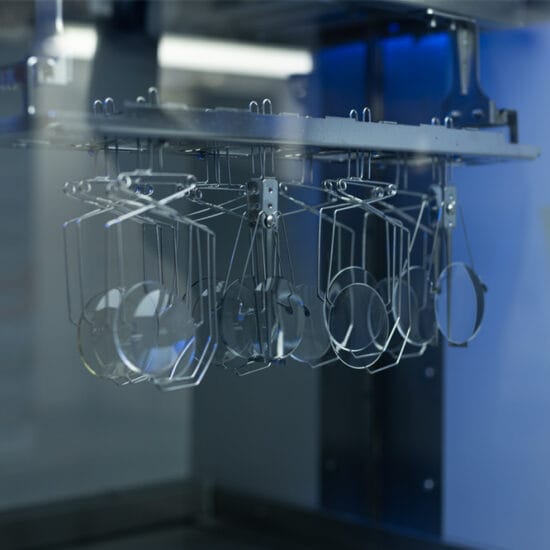
First, the lens does not have a moulded front surface, rather both the front and back surfaces have asymmetric curves cut or surfaced onto them. The mathematics and physics required for this design are far advanced compared to the older conventional design and to produce these lenses, the machines needed to be radically re-designed.
Second, now a ‘compensated’ power can be calculated and produced for the lens, which accounts for the ‘as worn’ frame adjustment measurements that have an impact on the effective powers of the lenses as the wearer uses them.
Measuring Premium Lenses
Conventional lenses always required the dispenser to provide the lab with monocular pupil distances and monocular heights. The three ‘as worn’ frame adjustment measurements are pantoscopic angle, frame wrap, and vertex distance. These measurements impact the effective powers of the lenses and for the conventional lens design, the labs always indicated the recommended parameters for each.
Generally, these were approximately:
- Pantoscopic angle: Between 8–12°,
- Frame wrap: Between 5 – 8°, and
- Vertex distance: Between 12–14 mm.
With free form design lenses, dispensers can now measure and provide the three exact ‘as worn’ measurements, and the lab can take these into account in the individual design of the lenses, as well as producing a compensated power accounting for them.
The principle behind compensated powers is based on the fact that the patient will experience a slight difference in visual acuity between the refractor head – which has zero pantoscopic angle, zero frame wrap, and a sometimes variable vertex distance – and the adjusted frame on their face. The aim of the compensated power is to account, as best as possible, for these additional variables. We want the visual experience, when the patient is wearing their finished lenses, to be as close as possible to what they experienced in the chair with the prescriber.
And this is what makes premium lenses premium.
But Wait, There’s More
In addition to this, lens suppliers are now offering even more considerations and inclusions, to further optimise the compensated powers and enhance the wearer’s visual comfort.
These inclusions and considerations also create points of difference between lens providers.
Sometimes an additional piece of equipment is required to capture the necessary additional data to facilitate these improvements. Lens laboratories are investing in new technologies – for example, EssilorLuxottica’s Varilux Physio Extensee and Rodenstock’s Biometric Intelligent Glasses (B.I.G.) lenses specify leveraging artificial intelligence, while CR Labs’ offering includes using a virtual reality headset to capture measurements. Another example is HOYA’s Consultation Centre 360 iPad App, to assist in personalising lens design selection.
Once again, it is the responsibility of the professional who is dispensing the lens advice to be across all these pertinent details.
When Fitting
Follow Instructions
Resist any temptation to deviate from the instructions provided by the lens laboratory, despite any personal feelings or anecdotal experiences. Lens labs are (justifiably) frustrated (perhaps even a little offended) when they come across optometrists and dispensers who make a deliberate deviation from the instructions. These instructions are carefully designed to produce the most favourable results and are the product of a huge investment in research and wearer trials.
Frame Adjustments
As has always been the case, the frame must have all adjustments made first and before any ‘as worn’ measurements are taken. And it is most critical that the customer understands and complies with the frame being fitted with the minimum vertex possible. This distance is dependent on various factors including the physiology of the customer, the eyelash length of the customer (a vertex too short can result in eye lashes brushing the back surface of the lens, which is very disconcerting), and the frame design itself. The shortest vertex possible is critical because it will maximise the field of view, especially noticeable in the near zone. This is crucial because one of the most challenging aspects of all progressive lens designs is the relatively narrow corridor and near zones, and the dispenser must do everything possible to minimise the loss of field here.
Attention to Detail
The dispenser must pay close attention to every measurement, the frame adjustment, the advice provided to the customer, and of course the data entry.
When taking the measurements, if possible, use the equipment and techniques as recommended by the particular lens supplier. Today this always includes the use of a digital measurement system, rather than the manual measurements of previous years. Dispensers need to keep in mind, though, that successful dispensing outcomes (despite the use of the latest digital systems) are still 100% dependent on operator skill, the frame adjustment, the lens selection, and the advice provided to the customer.
Selling the Value
Determining which lens is most suitable for the patient can be tricky. Certainly, price may be a consideration.
It is important then, for the dispenser to convey to the patient the additional benefits these lenses offer in return for the additional cost. We must advocate for the improved visual experience and comfort that comes as a result of the extensive design improvements, research and wearer trials, additional data inclusions, and upgraded manufacturing methods.
Your patient’s vision will feel more comfortable and natural than ever, any adaption period will be reduced, and the vision will most closely match what the prescriber was working towards when the original test was taken.
Take a look through the listings below, to see the latest in the premium multifocal lens offerings.
James Gibbins is a Director and Senior Trainer at the Australasian College of Optical Dispensing, which delivers quality training and continual professional development to meet the growing needs of the optical dispensing industry.
Varilux Physio Extensee

Varilux Extensee
EssilorLuxottica uses the power of artificial intelligence combined with the visual needs of the consumer to create the Varilux XR Series, the most premium progressive lens in the Varilux range.
Varilux Physio Extensee is the newest lens in the Varilux progressive lens family. Varilux Physio Extensee includes Pupiliser technology, which is derived from Essilor’s artificial intelligence (AI) twinning technology and dynamic pupil modelling. The result is that wearers report +18% improvement of contrast and sharpness compared to Varilux Physio 3.0 in all light conditions, even low light.1
A Eurosyn wearer study confirmed that overall, participants experienced visual sharpness and contrast in any light,2 including:
- 91% experiencing sharp contrast at all distances in any light condition,
- 89% experiencing a natural posture, and
- 89% experiencing sharpness in near vision.2
Varilux Physio Extensee is available with Near Vision Behaviour (NVB), and as the product variant: Varilux Physio Extensee Track, for personalised measurements.
Contact: EssilorLuxottica Account Manager
References
- Simulations vs Varilux Physio 3.0 – done with AI twinning technology during activities in near vision in various luminance. Comparison between means value based on several prescriptions and materials weighted by worldwide sales; Internal R&D simulations – 2024.
- Varilux Physio Extensee – in-real life consumer study – Eurosyn – 2024 – France (n=79 progressive lens wearers).
Hoyalux iD MySelf

Hoyalux iD MySelf
Hoyalux iD MySelf lenses are individually tailored progressive lenses that can vastly improve the quality and comfort of your patient’s vision. As a result of the latest integrated technologies including AdaptEase, 3D Binocular Vision, and Binocular Harmonization, internal research shows that Hoyalux iD MySelf brings significant improvements in areas that matter to your patients:
- Improved near and intermediate visual fields with no compromise on far vision,
- Optimised intermediate fields for the pleasant use of digital devices,
- An easy and fast adaptation curve, and
- Relaxed eyes, even during near tasks.
Hoyalux iD MySelf Profile provides wearers with an elevated visual performance, combined with a fuss-free consultation process. This lens makes customisation easy with five pre-defined design variants to meet the different vision needs of your customers.
HOYA offers the unique HOYA Consultation Centre 360 iPad App, which enables you to personalise the iD MySelf and iD MySelf Profile lens design selection based on the patient’s lifestyle and previous lens wearing history.
Hoyalux iD LifeStyle 4 is easy for wearers to adapt to as well as being easy for eye care professionals to prescribe. This new lens, with three design variants, takes into account today’s digital lifestyle need by introducing a new key technology: HOYA 3D Binocular Vision. It also comes with two additional corridor lengths.
Contact: HOYA Account Manager
Autograph Intelligence

Autograph Intelligence
Provide a lifelong vision solution with Shamir Autograph Intelligence – an innovative progressive lens designed with your patients’ evolving needs in mind.
Powered by big data, it breaks free from any assumptions, delivering personalised precision at every life stage. Whether it’s crisp distance clarity, seamless digital and mid-range support, or smooth transitions through changing prescriptions, this lens adapts intelligently.
Shamir touts the product as the first progressive lens of its kind optimally tailored to the individual wearer’s needs and visual age (the physiological age of one’s eyes).
Contact: Shamir info@shamirlens.com.au
Unity Via Progressive

Unity Via Progressive
The Unity Via Progressive lens portfolio features three easy-to-fit and dispense lens designs that are enhanced for today’s demanding visual needs, providing clear vision at all distances.
Your patients will enjoy seamless transitions from near to far, and a wide, distortion-free viewing area that ensures sharp and clear vision. From entry level to the most sophisticated product, Unity Via Progressive lenses are sure to meet the unique visual and lifestyle needs of any progressive patient.
Contact: VSP Optics (AUS) 1800 251 025 or (NZ) +61 2 9697 8080
SmartLife Progressive Individual 3

SmartLife Progressive Individual 3
ZEISS SmartLife Progressive Individual 3 lenses are meticulously crafted to meet the unique visual behaviours and needs of each wearer.
By taking into account age-related differences and analysing oculomotor behaviour alongside individual parameters such as anatomy, physiology, and habituation, these lenses provide exceptional refinement. Leveraging ZEISS Intelligence Augmented Design technology, the lenses align individual wearer data with over 12.5 million data points of visual behaviour across various age groups.
This advanced approach facilitates the development of optimally tailored lens designs, ensuring enhanced visual performance and comfort for everyday activities.
Contact: ZEISS (AUS) 1800 882 041 or (NZ) 0508 765 271
Biometric Intelligent Glasses (B.I.G.)

Biometric Intelligent Glasses (B.I.G.)
Powered by artificial intelligence (AI), Rodenstock can accurately predict the characteristics of the individual eye based on standard prescription.
Using this information, Rodenstock’s algorithms can accurately make decisions on the ideal lens design required to give optimum vision quality across the entire lens surface, producing visual comfort individually tailored to the patient.
The latest release from Rodenstock is B.I.G. EXACT Sensitive, a lens that incorporates both the biometry of the eye (the anatomic measurements of the eye, such as axial length) and the wearer’s individual visual sensitivity. To capture this information, Rodenstock’s DNEye Scanner acquires thousands of data points and parameters, while also determining the individual visual sensitivity across the patient’s field of view. Regardless of where a patient falls on the visual sensitivity spectrum, this lens design can be uniquely tailored to deliver the optimal visual experience.
Contact: Rodenstock Account Manager
Australis VR

Australis VR
Australis VR is CR Labs’ most advanced multifocal lens, designed to deliver exceptional visual clarity across all distances. Utilising innovative Gaze Dynamics technology, Australis VR adapts to natural head and eye movements, offering a smooth and intuitive visual experience.
The addition of CR’s patented technologies, MightyView and HyperThin, significantly reduces peripheral distortion while enhancing lens aesthetics, resulting in clearer, more comfortable vision and a sleeker appearance.
Proudly made in Australia, Australis VR is crafted with precision and care in CR Lab’s
Melbourne facility, offering optical professionals a premium solution that supports comfort, clarity, and performance for the most discerning multifocal wearers.
Contact: CR Labs (AUS) 03 8795 9111
NeuroSelect

NeuroSelect
Tokai offers the NeuroSelect series, which is distinguished by its foundation in neuroscience, harmonising optics and neuroscience.
The core aim of NeuroSelect is to provide exceptional comfort and effective vision by considering how the brain processes visual information. This lens aims to eliminate the peripheral sway and distortion often associated with progressive lenses, and account for the wearer’s neural processing. An ergonomics-based optical lens design with a neuroscientific technology, it quantifies subconscious sensitivity.
Contact: Tokai Account Manager
Optilux

Optilux
Opticare’s premium multifocal lens portfolio is designed to support eye care professionals in delivering clear, comfortable vision across all distances, tailored to each patient’s lifestyle and vision requirements.
The new designs include extremely low unwanted cylinder, wide and clear power channels, as well as easy adaptability, all ground locally in Opticare’s Sydney lab.
- Optilux Ultraclear – designed for early presbyopes/first-time wearers, provides easy adaptation into multifocal wear (adds up to +1.25),
- Optilux Panorama – a great multipurpose option for indoor and outdoor needs with a wide field of view, and
- Optilux Excellence – optimised for experienced wearers with a focus on tasks such as reading, screen use, and detailed indoor work.
Visit: opticare.com.au
Contact Lenses

Technology breakthroughs have made the best of premium multifocal contact lenses that can now offer superior visual performance through advanced optical designs and high-quality materials. These lenses differentiate themselves through customised optical zones, enhanced pupil optimisation and breathability, and exceptional stabilisation features.
When Fitting
Assessment
To optimise your success, the fitting process begins with a comprehensive pre-fitting assessment. If you are able to measure corneal topography, assess tear film quality, and evaluate lifestyle needs, this will guide you to ensure patient suitability and optimise your success rates.
To further enhance success, optimise your patient’s ocular surface health to manage any dry eye or lid conditions before prescribing.
Understanding several key factors can help you optimise how premium multifocal contact lenses work for each of your patients. These factors include: knowing the specific design characteristics of each lens option, selecting the most appropriate lens design based on the patient’s pupil size and visual demands, and considering their previous spectacle prescription when making your recommendation. Premium multifocals typically incorporate aspheric designs or multiple distinct optical zones to provide seamless transition between distance, intermediate, and near vision.
Follow Instructions
Another key to success is to follow the specific manufacturer’s fitting guide for that particular lens – these aren’t merely suggestions but have been based on countless patient experiences and extensive clinical research to reduce chair time and maximise fitting success. Each premium lens system has unique fitting characteristics requiring specific adjustments for optimal performance.
Allow Time and Follow-Up
Allow sufficient adaptation time. Premium multifocals require neural adaptation; patients should understand that optimal vision may develop over one to two weeks. Schedule follow-up assessments to evaluate centration, movement and visual performance. Fine-tune parameters based on patient feedback and clinical findings.
Remember that successful fitting combines technical expertise with patient education. The premium price reflects superior technology, materials, and visual outcomes – communicate this value clearly to enhance compliance and satisfaction.
Acuvue Oasys Max

Acuvue Oasys Max
Acuvue Oasys Max 1-Day multifocal contact lenses are the latest technology for presbyopia.
The intense demands of today are especially difficult as we get into our 40s and beyond. Combined with age-related vision changes, our tear films become less stable – a problem that spending increasing time on digital screens can exacerbate, leading to dryness and vision changes. Acuvue Oasy Max 1-Day multifocal contact lenses are designed to help tackle these issues head-on so your patients can enjoy crisp, clear vision and all-day comfort.* They incorporate the highest level of blue-violet light filtering available,±† with OptiBlue Light Filter, which blocks about 60% of blue-violet light.†
Contact: Johnson and Johnson Vision Care (AUS) 1800 736 912 or (NZ) 0800 466 173
References
* JJV Data from the Acuvue Oasys Max 1-Day in practice assessment, with 81 participating optometrists, and 605 spherical and 390 multifocal patients in the United States from July to October 2022.
± Versus publicly available information for standard daily use contact lenses as of December 2023.
† Filtering of high-energy visible (HEV) light by contact lenses may reduce some unwanted visual artifacts (such as light scatter, haloes, and starbursts), speed photostress recovery time, as well as reduce glare discomfort. It has not been demonstrated to confer any systemic and/or ocular health benefit to the user.
Ultra One Day

Ultra One Day
The Bausch and Lomb Ultra One Day multifocal contact lens combines three proven technologies providing outstanding end of day comfort and vision to help offer patients a viable alternative to spectacles for their presbyopic correction.1,2
Advanced MoistureSeal technology locks in 96% of contact lens moisture for a full 16 hours, providing outstanding comfort from morning to night, and ComfortFeel Technology, inspired by the TFOS DEWS II study, provides a unique combination of eye health ingredients to support and balance the ocular surface and maintain homeostasis.1
Additionally, the 3-zone progressive design provides effortless clarity and seamless transitions from near to far, for easy adaptation.3
Contact: Bausch and Lomb (AUS) 1800 251 150
References
- Rah M. Ocular surface homeostasis and contact lens design. Sponsored by Bausch and Lomb. 2021.
- Reindel W, et al. Impact of multifocal power profiles on visual outcomes. Contact Lens Spectrum. Special edition sponsored by Bausch and Lomb. 2016;31;32.
- Bausch and Lomb Data on File (2023). Study 916: A study to evaluate the product performance of a new silicone hydrogel multifocal contact lens – topline results. 2023 Mar 3. Sponsored by Bausch and Lomb.
UOD.0024.AU.25
Dailies Total 1 and Total 30

Total 30
Alcon’s multifocal contact lenses offer proprietary water gradient technology for exceptional comfort.1-2 The Precision Profile lens design delivers a smooth progression of power for clear, with uninterrupted vision from near to intermediate to far,†3 and up to 96% fitting success.†3,4
- Dailies Total 1 multifocal: The first and only water gradient daily disposable multifocal contact lens for exceptional comfort4 and seamless vision.5
- Total 30 multifocal (pictured): A monthly replacement multifocal contact lens that resists deposits5-7 and provides a gentle cushion of moisture8 for outstanding comfort all month long.9 It feels like nothing, even at day 30.*^10
Contact: Alcon Laboratories (AUS) 1800 224 153 or (NZ) 0800 101 106
References
† With two lenses or less, at initial fitting visit, based on three different clinical studies; n=100–175 subjects.
*Applicable to sphere and multifocal only.
^Based on more than 70% of wearers agreeing with the statements ‘These lenses were so comfortable I didn’t feel anything’ and ‘I did not have to think about my contact lenses today’; n=66.
- Efron N et al. Cont Lens Anterior Eye. 2022. doi: 10.1016/j.clae.2021.101515.
- Kern J et al. Invest Opthal Vis Sci. 2013;54(15):494.
- Based on a report detailing the Precision Profile lens design; Alcon data on file, 2016 [REF-01717].
- Shi X et al. Colloids Surf B: Biointerfaces 2021. doi: 10.1016/j.colsurfb.2020.111539.
- Lemp J, Kern J. Alcon multifocal contact lenses for presbyopia correction. Paper presented at the Canadian Association of Optometrists Congress; 28–30 June 2017; Ottawa, ON.
- Ishihara K et al. ACS Omega. 2021. doi: 10.1021/acsomega.0c06327.
- Alcon data on file, 2021. V-RIM-0035878:1 [REF-11720].
- Alcon data on file, 2021. A02491-REP-198231-1:4,7,8 [REF-11404].
- Baker K, Merchea M. Impact of pupil diameter on multifocal contact lens vision. Poster presented at American Academy of Optometry Annual Conference, 9 Nov 2018. San Antonio, Texas.
- Alcon data on file, 2021. [Summary of the CLY935-C013 study p4, available from phone 1800 224 153 (AU), 0800 939 999 (NZ)] [REF-11403].
ANZ-T3M-2500001.
MyDay Multifocal

MyDay daily disposable
Success is simple with MyDay multifocal.1,2 Data on file shows first-fit success in 83% of patients, and 98% successfully fitted with two pairs or fewer.1,2*
Contact: CooperVision (AUS) 1800 655 480 or (NZ) 0800 606 060
Warning: UV-absorbing contact lenses are not substitutes for protective UV-absorbing eyewear, such as UV-absorbing goggles or sunglasses, because they do not completely cover the eye and surrounding area. Patients should continue to use UV-absorbing eyewear as directed.
*When using the fitting guide.
References
- CVI data on file, 2021. Prospective, subject-masked, randomised, bilateral, two-week dispensing study at five US sites with MyDay daily disposable multifocal; n=58 habitual multifocal contact lens wearers.
- CVI data on file, 2020. Prospective, double-masked, bilateral, one-week UK dispensing study with MyDay daily disposable multifocal contact lenses; n=104 habitual multifocal contact lens wearers.