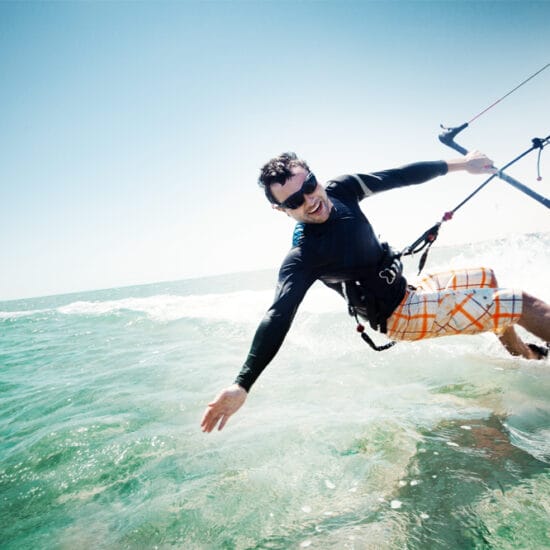
Australia – our lucky, yet sunburnt country – has some of the highest levels of ultraviolet (UV) radiation in the world. Eleven minutes is all that is needed for sunburn to begin on a clear summer day.1 As eye health professionals, we have an obligation to ensure our clients understand the benefits of sun protection for their eyes.
According to the World Health Organization, the chronic effects of exposure to UV radiation include cataracts, pterygium, and cancer in and around the eye. It may also be involved in the development of age-related macular degeneration.2 As one of the best natural sources of Vitamin D, exposure to UV from the sun does not need to be eliminated, rather we need suitable sun protection to achieve balance.2 Outdoor eyewear is a crucial component of any sun protection strategy.
It is a well-known fact among optical professionals that one pair of glasses cannot do it all. Expert eye care means expert tailored recommendations for a customer’s unique needs. For use outdoors, various tint colours, polarising filters, and photochromic lens options are available – in addition to UV protection – and can be matched to a customer’s unique needs.
UV Protection
In Australia and New Zealand, all sunglasses and fashion spectacles must be tested and labelled according to the Australian/New Zealand Standard for Sunglasses and Fashion Spectacles (AS/ NZS 1067:2016 Eye and face protection: Sunglasses and fashion spectacles).3 All eyewear, which includes uniformly tinted, polarising, photochromic, and gradient-tinted lenses, sold in Australia and New Zealand, is graded according to five lens categories, with categories 0 and 1 providing “some” UV protection, and categories 2–4 providing “good” UV protection (Table 1).
The standard does not cover either tinted or clear prescription glasses, but certain lens materials and coatings can provide UV protection.4

Table 1. Lens category standards. Source: Australian/New Zealand Standard AS/NZS 1067.1:2016. Adapted from Cancer Council fact sheet.4
Considering the Needs of Customers
How can we identify the unique outdoor needs of our customers and the visual demands these will present? Rodenstock Australia Professional Services Manager, Alex Rigby recommends a broad approach.
“Rather than asking directly, ‘Do you play sports?’, ask ‘What types of physical, fitness, or leisure activities do you enjoy?’. This helps you avoid excluding individuals who may not consider their hobbies as sports, even though they may involve outdoor activities and warrant task-specific eyewear.”
Mr Rigby recommends engaging clients in further meaningful discussions to understand the visual and physical demands of the task at hand. Topics such as movement type and range, speed and direction changes, object size, tracking, and durability should be considered.
In addition, Mr Rigby recommends consideration of the environmental conditions and the visual impacts they will have. Consider the normal lighting conditions, how glare or contrast affect the activity, and the unique features – for example snow or water.
“Understanding these factors allows you to make informed recommendations for lens tint, coatings, or mirror finishes,” Mr Rigby said.
Once the details of the outdoor activity and the associated conditions are identified, optical dispensers can make informed recommendations for tailored solutions for various outdoor activities.
Depending on the physical, environmental, and visual needs of the customer, dispensers have an array of options to offer. Colour selection in these scenarios will largely depend on customer preference.
Walking and Hiking
From leisurely lakeside strolls to mountain hiking, sunglasses are an essential in the tool kit.
Depending on the physical, environmental, and visual needs of the customer, dispensers have an array of options to offer. Colour selection in these scenarios will largely depend on customer preference.
Grey will provide natural colour vision, but low contrast. Green, a mid-contrast, and brown, a high contrast.
For hiking in particular, where uneven surfaces are an issue, Mr Rigby explained contrast against the ground is an important consideration; a brown lens tint would fit the bill here.
Water and Snow
A polarised lens will provide a customer with a multifunctional outdoor lens for use in various settings.
National Training and Development Manager from the Opticare Academy, Craig Johnson, explains that “when near any type of water, the first choice is always polarised lenses”.
He said colours are not as critical for general use around the water, so grey or green tints will work perfectly.
“Fishing, however, requires a brown tint as the contrast between the colour of the water is enhanced and thus fishers can see more depth as well as pick up movement/fish under the water easier.”
Polarised lenses are also recommended for outside in the snow, where UV levels can be a lot higher; UV is more intense at higher altitudes, and the snow can reflect up to 90% of UV radiation. However, certain sports or activities that require precise depth perception or the ability to see specific reflections may not be well-suited for polarised lenses. This is a case-by-case basis, because with activities such as skiing and snowboarding, subtle changes in light and reflections play a significant role in performance and safety. For snowboarding in particular, glare plays a key role in distinguishing ice from snow.
Amber or rose-coloured ski sunglasses (or goggles) will increase the visibility of ridges or bumps in the snow’s surface. Darker lenses like grey, brown, or rose are ideal for bright, sunny days to reduce glare and enhance contrast. Lighter lenses – yellow, orange, or rose – are better for overcast snow days as they increase contrast and visibility.
Golf
Golf tests concentration, precision, and patience, and presents unique visual challenges associated with contrast and depth perception.
Mr Rigby recommends high contrast tints, such as orange for dynamic conditions, to enhance vision on the golf course. Rodenstock’s ColorMatic Sun self-tinting lenses adapt to the respective lighting conditions with tint density varying from 40–90%, managing both light transmission and contrast enhancement.
There is controversy surrounding the benefits of polarising lenses for golf. While highly effective for glare reduction, on the fairway this can lead to difficulty tracking the ball both in the air and on the ground; glare is beneficial in golf for visibility. Polarising can also mute the ability to see and judge subtle changes in the fairway.
Mr Johnson recommends citing the benefits of copper and brown tints to “highlight the ball and also allow the golfer to pick up the undulations of the fairway”.
Paediatric Considerations
Children are in and out of doors countless times throughout a day – playgrounds, backyards, weekend sports, beach visits, bush walks – the outdoor daily activities are plentiful. It is estimated that “around 40–50% of total UV to age 60 occurs before age 20”.5 However, increased outdoor time for children is encouraged as one of the preventative methods in myopia management.6,7 To manage this requirement within Australia’s harsh UV conditions, sun protection for children is paramount.
The Cancer Council Australia’s fact sheet,4 which is endorsed by the Royal Australian and New Zealand College of Ophthalmologists (RANZCO), recommends close-fitting, wraparound sunglasses that meet the Australian/New Zealand Standard for sunglasses (categories 2-4) (Table 1).
Lens options are numerous for children’s sun protection, depending on their lifestyle, age, and prescription needs. For convenience and a proactive approach, photochromic lenses are an ideal option for children who require prescription glasses. Photochromic lenses will ensure eye sun protection is accounted for, reducing the need for multiple pairs and the risk of misplacing specs when changing pairs.
Hoya’s MiyoSmart Sun range addresses the need for sun protection while providing defocus incorporated multiple segments (DIMS) technology for myopia control. The range encompasses the MiyoSmart Sunbird, a grey polarised lens, and the MiyoSmart Chameleon, a grey photochromic lens.8
The Evolving Scene of Photochromic Filters
We are seeing a rise in the popularity of photochromic filters with optical dispenser, Brad McMillan of Young Eyes Optometrists in regional New South Wales, explaining, “more people are asking about photochromic lenses than ever before”.
“The technology has come a long way too, with faster transitions, more stylish colours, and better performance overall. I think people are just more aware now of how important eye protection is, and they want something that’s both practical and protective.”
Long-standing classic Drivewear lenses by Transitions and Younger Optics change between three colours when activated by the relevant UV demands.
HOYA’s Sensity lenses provide a suite of photochromic options that can be matched to customers’ requirements, including increased colour options, darker activation, mirror coating, and fast adaptation times.
Mr McMillian said the impact of these advancements in technology is that, “the stigma around photochromic lenses being ‘old person glasses’ has faded quite a bit”.
“The newer style colours have really changed the game. They look better than the old grey lenses, which used to take ages to fade back to clear and just weren’t very stylish. Now the lenses change faster and look great. It’s easier to recommend them to all ages, especially younger people who care about how their glasses look. From my own experience, I probably won’t wear another progressive without transition lenses. Photochromics are practical, comfortable, and now fit with a modern style; the newer technology has broken down a lot of old perceptions.”
Wrapped sporting frames offer many functional advantages, such as a secure fit and wider viewing areas.
What About the Frames?
Prescription sunglasses have a dual functional purpose of optical correction and sun protection. Special consideration needs to be given to the frame features to achieve a harmonious balance of these purposes while still meeting the customers’ aesthetic and comfort needs.
Is an increase in size appropriate? This will provide greater coverage and hold many lens styles. The customer-specific facial and optical requirements should be balanced when making this decision. For high prescriptions or petite features, clear optical frames can offer a more suitable solution.
An increased face form angle, or wrap, will also enhance sun protection by blocking peripheral light exposure. Wrapped sporting frames offer many functional advantages, such as a secure fit and wider viewing areas. Complementing wrapped sunglass frames with a sports lens is essential to ensure optimal optics. As Mr Rigby explained, “sports lenses are engineered for dynamic visual circumstances and the environmental conditions that are associated with that athletic performance”.
“Dispensing must support and not compromise the visual function, so any lens solution must complement and never interfere with the patient’s natural visual skills.”
In addition, a well-fitted bridge will ensure the lenses are positioned with optimal coverage. Where appropriate, a thicker temple can also help block sunlight from the sides, however a good final fitting with appropriate pantoscopic tilt should be maintained.
Take a look below to see some of the sun protection options available.
Virgilia Readett is a Senior Trainer with the Australasian College of Optical Dispensing (ACOD). She holds a Certificate IV in Training and Assessment, a Certificate IV in Optical Dispensing and a Bachelor of Arts, majoring in Communications.
Ms Readett has been in optics since 2012 and has been teaching with ACOD since 2019.
References
- Cancer Council NSW, When is sun protection needed? (webpage) available at: cancercouncil.com.au/cancer-prevention/sun-protection/understanding-uv-radiation/when-is-sun-protection-needed-to-protect-your-skin/ [accessed August 2025].
- World Health Organization, Ultraviolet radiation (webpage) 2022. Available at: who.int/news-room/fact-sheets/detail/ultraviolet-radiation [accessed July 2025].
- Saks A. Control the light: UV protecting lenses, mivision. 2021(165):92. Available at: mivision.com.au/2021/03/control-the-light-uv-protecting-lenses [accessed August 2025].
- Cancer Council, Fact sheet: Eye protection. Available at: cancer.org.au/about-us/policy-and-advocacy/prevention/uv-radiation/related-resources/eye-protectionhttp://cancer.org.au/about-us/policy-and-advocacy/prevention/uv-radiation/related-resources/eye-protection [accessed August 2025].
- Green AC, Wallingford SC, McBride P. Childhood exposure to ultraviolet radiation and harmful skin effects: epidemiological evidence. Prog Biophys Mol Biol. 2011 Dec;107(3):349-55. doi: 10.1016/j.pbiomolbio.2011.08.010.
- Lingham G, Mackey DA, Lucas R, Yazar S. How does spending time outdoors protect against myopia? A review. Br J Ophthalmol. 2020 May;104(5):593-599. doi: 10.1136/bjophthalmol-2019-314675.
- Lawrenson JG, Dhakal R, Walline JJ, et al. Interventions for myopia control in children: a living systematic review and network meta-analysis. Cochrane Database Syst Rev. 2021 Apr 7;2021(4):CD014758. doi: 10.1002/14651858.CD014758.
- Hoya. MiyoSmart Sun (webpage, 2024) available at: hoyavision.com/au/vision-products/miyosmart/miyosmart-sun/ [accessed August 2025].
The Sunglass Edit
Marchon

Marchon
Prepare for the warmer weather ahead with Marchon’s Sun Rx program, a premium prescription sunglasses offer designed to boost your bottom line and elevate your in-store offering.
Enjoy access to Marchon’s curated sun Rx catalogue of renowned brands, including Calvin Klein (pictured) and Nike, and pair with any prescription grind lens from the VSP Optics lens portfolio – that’s more than 300+lens options to choose from – giving you complete flexibility to meet your patients’ needs. You can also unlock exclusive sunglass frame discounts and enjoy the perks and ease of a streamlined supply chain.
Contact: VSP Optics (AUS) 1800 251 025 or (NZ) 0800 141 444
CR Labs and Safilo

CR Labs and Safilo
The CR Labs SMITH Rx program, in association with Safilo, offers high quality outdoor prescription sunglasses featuring ChromoPop lenses, ideal for sports like fishing, skiing, and biking.
These lenses enhance contrast and natural colour, providing superior clarity and performance in various light conditions.
SMITH’s innovative eyewear combines style with functionality, making it a perfect choice for outdoor enthusiasts.
Contact: Safilo or CR Labs Account Manager
Maui Jim

Maui Jim
Maui Jim has become a global leader in prescription eyewear thanks to its patented PolarizedPlus2 lens technology, delivering unmatched colour, clarity, and detail.
With two state-of-the-art labs in the United States and Germany, every lens is digitally crafted, ensuring 10 times the accuracy of conventional methods. Its MauiPassport 2.0 lenses offer edge-to-edge clarity, while MauiBrilliant lenses deliver nearly glass-like optics at a third of the weight. Maui Jim’s new MauiUltra prescription lenses combine advanced digital surfacing with proprietary lens materials to deliver superior colour, impact resistance, and all-day comfort for the most demanding visual needs. Full in-house control guarantees exceptional turnaround times, quality assurance, and sustainability. Maui Jim offers retailers a seamless ordering experience and singular touchpoint, all backed by Maui Jim’s renowned industry leading customer service.
Contact: Maui Jim Australia (AUS) 1800 099 424 or rx.au@mauijim.com
Convertibles

Convertibles
The Convertibles Neo 93008 combines modern versatility with effortless style.
Featuring a sleek, clear grey optical frame paired with new black magnetic sun clip-on technology, this design seamlessly transitions from indoor to outdoor wear.
The lightweight construction ensures comfort throughout the day, while the polarised sun lenses provide superior UV protection. Perfect for individuals who value convenience without compromising on aesthetics, Convertibles embodies smart eyewear innovation. Ideal for everyday use, from office hours to outdoor adventures.
Visit: Optiqueline.com.au or Optiqueline.co.nz
De Rigo x Rodenstock

De Rigo x Rodenstock
De Rigo, a global expert in premium eyewear, and Rodenstock, a leader in high-quality German-engineered lenses, have joined forces in the De Rigo x Rodenstock frame and lens package program. This initiative is designed to boost practice profitability with innovative solutions backed by proven industry expertise.
Savings of up to 50% are available on complete packages with direct lab ordering, complimentary fitting, and a wide selection of frames and sunglasses.
This season, discover new sunglass packages from Police, Furla (pictured), Fila, and Yalea. Furla packages feature Rodenstock’s premium Lambda lenses for enhanced contrast and colour. Police, Fila, and Yalea packages include high-quality polarised lenses and optional ColorMatic X – Rodenstock’s fastest, clearest photochromic lenses.
Contact: De Rigo sales@derigo.com.au or (AUS) 02 9428 1500
MAKO

MAKO
The MAKO Rx program offers premium prescription sunglass technology at competitive prices. The program is designed to be simple and transparent, with all pricing inclusive of frame costs.
Every MAKO lens, prescription or plano, features polarisation, anti-reflective, oleophobic, and hydrophobic coatings for superior visual performance.
The lens range includes 1.5, 1.6, 1.67, 1.5 Drivewear, 1.53 Photochromic, and 1.6 Crown Glass indexes, with mirror options in blue, green, silver, and red. Available lens types include single vision, progressive, and prescription bifocal.
Contact: info@makoeyewear.com.au or (AUS) 02 8436 6666
The Lens Lineup
Photochromic and Prescription Solutions
Shamir

Shamir
Shamir combines premium vision correction and fashion with its PhotoGlamour range. These lenses employ Transitions technology that activates in sunlight, then rapidly fades back to clear when inside, retaining their light tint colouring. This dynamic system helps the wearer adapt to all light conditions while maintaining great style.
Help patients find their style, with many vibrant options to choose from. Popular uniform colours are Jupiter, Venus, and Neptune while gradient colours include Americano, Cosmopolitan, and Curacao.
Contact: info@shamirlens.com.au or (AUS) 1300 553 465
VSP Optics

VSP Optics
VSP Optics’ photochromic solutions include SunSync and SunSync Drive XT.
Original SunSync is a conventional light-reactive lens that gives you everything you want in a base lens that’s anything but basic: dark outdoor colour, excellent indoor clarity, fast reaction times, superior temperature stability, 100% UV protection, and outstanding durability in one stylish package.
SunSync Drive XT combines the benefits of in-car activation with all the advantages of SunSync lenses.
Both SunSync and SunSync Drive XT are backed by a one-year, 100% satisfaction guarantee, allowing you and your patients to try them risk free for 12 months.
Contact: VSP Optics (AUS) 1800 251 025 or (NZ) 0800 141 444
Transitions

Transitions
Transitions lenses provide more than standard vision correction – they offer smart light adaptation, block 100% UVA and UVB, are blue-violet light filtering,1 and come in a choice of colours, blending protection, performance, and personal style in one vision solution. Transitions Gen S is fully clear indoors, darkens to category three in seconds, and fades back in around two minutes.2 XTRActive new generation is ideal for light-sensitive wearers, offering extra darkness outdoors and activating behind the windshield.3 XTRActive Polarised has up to 90% dynamic polarisation,4 significantly reducing glare – delivering sharper vision, vivid colours, and a larger view outdoors.5
Contact: EssilorLuxottica (AUS) 1800 210 190
References
- For polycarbonate and CR39 lenses across colours. Blue-violet light is between 400 and 455 nm (ISO TR 20772:2018).
- For polycarbonate and CR39 lenses across colours achieving 18% transmission at 23°C.
- Polycarbonate and 1.5 grey lenses tested at 23°C behind the windshield achieving between 18%T and 43%T.
- Based on tests across materials on grey lenses at 23°C, using ISO 12312-1 standard.
- EcoOptics Limited – Prof Nicholas Roberts, Quantitative study evaluating the visual benefits of the polarisation properties of lenses compared to similar non-polarised lenses, 2019/2020.
HOYA

HOYA
HOYA’s sun lens range offers advanced solutions for every lifestyle. From Sportive lenses for curved frames to Sensity photochromic options – Fast, Dark, Shine, and Sensity 2 – each adapts seamlessly to changing light. Sensity Fast leads with rapid fade-back indoors, while Shine adds a stylish mirror effect.
The new Sensity Colours collection enhances personal style with six vibrant solid and gradient tints, offering 100% UV protection and glare reduction. HOYA also features Polarised, Mirror, Light Mirror, and Hi-Vision Sun Pro coatings for optimal clarity and aesthetics. Discover sun lenses that combine fashion, comfort, and performance.
Contact: HOYA Account Manager
ZEISS Vision Care

ZEISS Vision Care
Designed for both style and performance, ZEISS outdoor lens solutions cater to modern eyewear trends while delivering the trusted optical quality ZEISS is known for. The expanded range of sun tints within its outdoor lens portfolio includes four new tinted colours – copper brown, dusk grey, midnight blue and burgundy.
Due to increased demand in ZEISS AdaptiveSun lenses, ZEISS expanded the colour range with the addition of a blue lens. ZEISS AdaptiveSun lenses adjust from dark to darker: performing everywhere, ranging from overcast to bright light conditions, and covering a light absorption of 60% up to 97% for any light conditions.
Contact: ZEISS Account Manager
Younger

Younger
NuPolar polarised lenses deliver exceptional visual performance, durability, and value. Colours stay true without fading, while superior film adhesion and heat stability eliminate delamination – even in hot cars. With a wide range of solid and gradient tints, fashionable mirror finishes, and photochromic options, NuPolar offers solutions for every lifestyle. Available in multiple materials and designs.
Transitions Drivewear (pictured) is the world’s only polarised lens with both colour and light-adaptation technology. Transitions Drivewear uniquely shifts through three colours while remaining polarised at all times: olive in low light, copper behind the wheel or in variable daylight, and dark brown in bright sun. Transitions Drivewear darkens and lightens as conditions change for impressive contrast, clarity, and comfort.
Visit: youngeroptics.com.au or call (AUS) 08 8241 9800