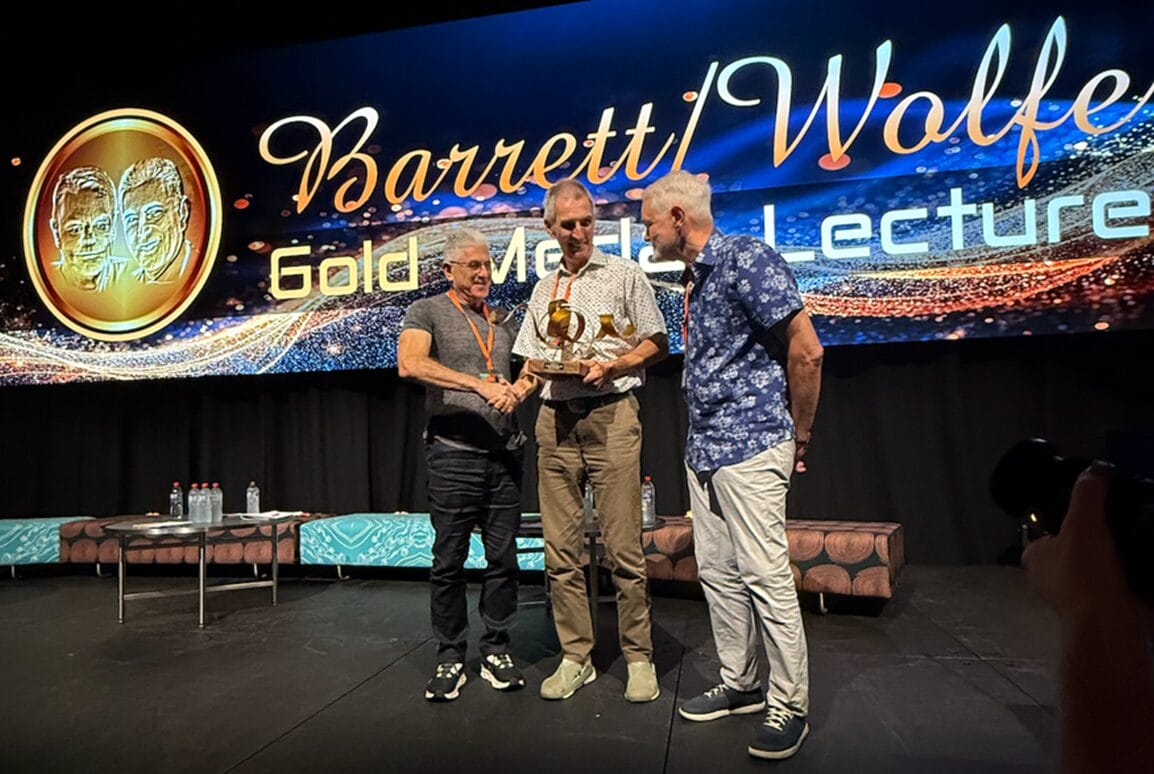
Professor Graham Barrett and Dr Rick Wolfe present the Barrett/Wolfe Gold Medal trophy to Prof Michael C Knorz.
Known for blending serious science with good humour, friendship, and well-planned costumery, the Australasian Society of Cataract and Refractive Surgeons (AUSCRS) once again delivered an event that was as memorable for its education as it was for its sense of fun.
Alan Saks was among the delegates enjoying the record-breaking exhibition and lively conference sessions, held at the Darwin Convention Centre and themed ‘Disconnect to reconnect: Experience the top end in every sense’.
The educational sessions kicked off with the Barrett/Wolfe Gold Medal Lecture delivered by Professor Michael C Knorz (Germany), a respected AUSCRS regular. He covered some of the milestones of intraocular lens (IOL) evolution, in this 75th anniversary year of IOLs, noting that bifocal and multifocal IOLs (MF IOLs) have been around since the mid-1980s.
We currently have two major presbyopia correcting IOL options: extended depth of focus (EDOF) and full-range multifocal/trifocal IOLs. They can be refractive or diffractive, each with their own pros and cons. One of Prof Knorz’ studies revealed that of the 5% unhappy MF IOL patients, 4.5% were dissatisfied due to residual refractive error. The remaining 0.5% reported irritating optical side effects associated with trifocal lenses.
He stressed the critical importance of planning refractive end points and optimising biometry, while emphasising the importance of communication: talk and show empathy.
Residual refractive error is treatable after three to six months of adaption and stabilisation, through limbal relaxing incisions, add on ‘piggyback’ IOLs, and laser refractive surgery tweaks.
Lens exchange was rare – with only one case reported in his series of 1,921 cases (0.05%) and should not be done before six months. The dominant eye should be exchanged first, targeting distance vision while retaining the MF IOL in the other eye, to enable reading/social vision. If a patient is happy on day one, but reports dissatisfaction later, then YAG for posterior capsular opacification (PCO) is indicated. If unhappy from day one, then IOL exchange is indicated. EDOF patients are more likely to need top-up reading glasses. He went on to discuss glare and haloes, elaborating on the pros and cons of a variety of proprietary designs.
Prof Knorz suggested that presbyopia-correcting IOLs will become the standard of care, refractive EDOF IOLs will slowly replace monofocals, and refractive MF IOLs will replace diffractive MF IOLs.
Communication was a dominant theme throughout the conference and numerous other surgeons also discussed aspects of MF IOLs and a variety of proprietary designs.
Changing Gears
After the entertaining and educational rapid-fire sponsor sessions, AUSCRS co-chairs Dr Jacqueline Beltz (Melbourne) and Professor Gerard Sutton (Sydney) went on to chair ‘Challenging cases: Ophthalmology: A game of thrones.
Professor Sathish Srinivasan (Scotland) presented a remarkable case in ‘Let’s pop the balloon’, of a large iris cyst that would not stay away after treatment, recurring four times after draining and 5FU (fluorouracil). He then took a more radical – and ultimately effective approach (cyst wall excision) – leading to cataract, IOL and the necessity of a custom artificial iris.
In his presentation ‘Complex traumatic cataract saves’, Dr David Lockington (Scotland) detailed an emergency repair of the right eye of a 43-year-old male following a high velocity industrial trauma accident. Corneo-limbal laceration, total iris loss, cataract, counting fingers acuity, glare, aphakia, aniridia, a fibrotic capsule, and contact lens intolerance were some of the challenges. He proceeded to an optic capture IOL, custom artificial iris, a drainage tube for high intraocular pressure (IOP) and vitrectomy resulting in 6/9 vision.
In his presentation ‘Therapeutic refractive correction post cataract surgery’, Professor Jod Mehta (Singapore), another AUSCRS regular, detailed refractive end points in IOL surgery, in his usual rapid-fire style. He noted that British IOL pioneer Sir Nicholas Harold Lloyd Ridley’s first lOL success in 1950 had a residual refractive error of -20D, but in the following adjusted series, many patients were within 1D of emmetropia. Ridley went on to implant 1,000 IOLs in the next 12 years. A 2008 study by Norrby1 showed a mean absolute error of 0.4D. Around 96% of patients were within +/- 1D. Today, the majority of surgeons attain 74% within +/- 0.5D.
Prof Mehta discussed factors affecting IOL refractive outcomes, predictors of effective lens position, and the accuracy of each IOL formula. The availability of IOLs in smaller dioptric increments, fourth generation formulae, and small incision/foldable IOL surgical techniques, have driven refinement.
When patients/surgeons are unhappy with a refractive surprise/end point, Prof Mehta said excimer-laser refractive refinements can save the day.
He explained that excimer has evolved into flying spot delivery, larger diameters, refined wavefront-guided optimised ablation profiles/patterns, and spherical aberration control – while higher frequency lasers and improved eye trackers help minimise fixation errors.
He noted that small aperture IOLs can be used in one eye, particularly where irregularities and associated aberrations make other options riskier.
Other speakers in this session also detailed effective lens position and related issues, which were discussed further by a panel.
Dr Matt Rauen (United States) discussed ‘Lower intraoperative intraocular pressures in standard and complicated cataract surgery’. Changes are afoot, with the future of phacoemulsification moving toward active fluidics, away from the more traditional passive fluidics. Intraocular pressures during traditional phaco, being artificially increased up to 65 mmHg, can induce anatomical abnormalities, creating potential for reverse pupillary block and lens-iris diaphragm retropulsion syndrome, as well as endothelial changes and slower corneal recovery.
He presented evidence that there’s no compromise in efficiency with lower IOP surgery, and that lower infusion pressure is beneficial. There is less fluid use/leakage, lower temperature, less patient discomfort, and reduced need for anxiolytics/analgesics. It helps make complex cases more routine. He illustrated some of these points with surgical videos including a dense cataract case.
In contrast to all the latest technology, Dr Yachana Shah (Perth) presented on cataract care in the remote Kimberley region in far north-western Western Australia. She explained that phaco techniques are often not possible in remote settings due to late presentation of mature cataracts, trauma, equipment failure/delayed servicing, and co-morbidities.
She demonstrated how manual small incision cataract surgery (SICS) – an evolution of extracapsular cataract extraction – is a pragmatic and successful option. The cataractous lens is removed through a self-sealing scleral tunnel, held closed by internal pressure, and is watertight. It’s important to have a backup technique, which acts as a surgical safety net. SICS enables consistent, confident care in the field and better access. Adaptable surgery provides equity in care.
To close off the opening day’s presentations, Dr Alison Chiu (Sydney) and Dr David Kent (New Zealand) chaired ‘The eye-pocalypse’ session. Various aspects of kerato-lenticule extraction (KLex) surgeries were covered.
Professor Colin Chan (Sydney) presented data from various studies showing that cyclotorsion – induced when moving from the measured upright position to surgical supine position – varied from 1–4.1°. Though not large, it can be significant in higher degrees of astigmatism. He went on to detail an iris-based refractive surgery alignment system to compensate for cyclotorsion.
Others in this session looked at nomograms and vector analysis to enhance outcomes, the effect of laser frequency and spot size, suction interface, centration, patient age, presbyopia options, and top tips for success, covering a variety of proprietary KLex systems.
Moving Along
The Friday sessions kicked off with a head-to-head session on IOL choices: ‘Superheroes vs villains’ where doctors Basak Bostanci (Türkiye), Lewis Levitz (Melbourne), Cathy McCabe (United States), Cameron McLintock (Brisbane), and Ravi Patel (United States) presented some entertaining and well-structured presentations and videos, promoting their choice of proprietary IOL designs and surgical platforms. Dr Levitz came out on top with his convincing presentation as ‘The Riddler’. In promoting a first-choice lens, data needs to be presented to show why a change to new lens design is beneficial. It was stressed that a patient must have good vision in the dominant eye, and that accurate end points are critical, as is management of complications.
Dr Anton van Heerden (Melbourne) presented on Irvine-Gass syndrome, aka pseudophakic cystoid macular oedema (PCMO). Backed by research, he showed why a ‘dropless strategy’ utilising subconjunctival triamcinolone injection is likely to become a standard procedure for the prevention of CMO after cataract surgery, with the potential to improve patient outcomes. He detailed different dosage strategies, associated risk profiles, and potential side effects, noting that it should be avoided in glaucoma/at-risk patients.
In her presentation on dry eye disease (DED), Dr Alice Epitropoulos (United States) spoke about the importance of identifying DED in cataract-ready patients, given the tear film is the most important refracting surface of the eye. An unstable tear film can result in unpredictable pre-operative measurements, delayed healing, and suboptimal post-operative results and symptoms. In one study2. she noted that 64% of patients had an abnormal tear break up, 77% of eyes had corneal straining but only 13% were reported to be symptomatic. It’s critical to treat and then evaluate resolution of DED before IOL calculations, to ensure more precise keratometry readings and biometry. She detailed numerous diagnostic tests for dry eye, as well as the ever-increasing number of effective treatment regimens, ranging from basic low-cost items to expensive in office procedures and equipment. Artificial intelligence (AI)-powered tools are making headway in analysing tear film and ocular surface images, so we can expect more effective predictive analytics for early detection and personalised treatment plans.
In a session on the future of IOLs, chaired by Dr Ben LaHood (Adelaide) and Professor Graham Barrett (Perth), Associate Professor Bostanci gave an enlightening talk, detailing light adjustable/modulating lenses, as well as those containing mesogens (flexible compounds that exhibit properties similar to liquid crystals), that can also be adjusted postop to tweak refractive outcomes.
Interchangeable IOLs were mentioned as a means of resolving issues following congenital cataract surgery, in cases that develop retinal problems, intolerance, or dysphotopsia.
Matching the precision of optics with the complexity of human vision remains a challenge. As we’ve heard in the past – the real future of IOLs is in the quest to optimally manage presbyopia and for patients to be spectacle free. The development of shape-changing accommodating IOLs remains the holy grail. Assoc Prof Bostanci showed various technologies in development, and how these IOLs may interface with the capsule and ciliary body. These may take the form of multi-piece IOL systems, those that keep the capsular bag open, fluid filled lenses that respond to changing vergence of light, and those that interact with the ciliary body.
The ensuing panel discussion revealed mixed approaches to IOLs and presbyopia but seemed to follow a preference for monofocal IOLs, ‘mini-monovision’, and EDOF, followed by MF IOLs, while delegates showed a preference for EDOF and blended vision/monofocals followed by MF IOLs.
In her talk ‘Premium IOLs: Matching patients to technology’, Dr McCabe stressed the need to have a thorough and direct discussion with patients, keep accurate records, and note if a patient does not appear suited to specific IOL solutions they insist on.
In ‘Lost (endothelial cells) in space!’, Prof Barrett stressed that endothelial cell counts are critical. Even greater caution should be taken in patients with Fuchs’ dystrophy. Surgical technique and reduced phaco power/IOP are important considerations.
In an entertaining session, ‘Cataract surgery challenges: The block’, one team member presented while the other constructed a kit house. A series of interesting videos and presentations on overcoming challenging cataract surgery cases ensued.
In a three-way debate Drs McCabe, Lockington, and LaHood returned to the stage, to respectively present on how the United States, United Kingdom, and Australia were taking on the challenges of sustainability, reducing the environmental impact of ophthalmology in general, and surgery in particular. Dr McCabe won this debate, taking the inflatable crocodile trophy.
The Final Day
In a session discussing AI powered phakic IOLs, Dr Roger Zaldivar (Argentina) explained how an AI-driven implantable collamer lens (ICL) software program helps refine and improve outcomes and safety by determining the ideal ICL to use in a given case. Al helps to select the best ultrasonic biomicroscopy (UBM) images and data, predicts the location of the lens, and estimates potential lens deformation, using mathematics to assess angle distortion. Dr Zaldivar’s team of researchers investigated metrics in an analysis of ICL footplate position, using a high-frequency ultrasound robotic scanner.
He walked through how to use such software with illustrative cases, tips, and the variables to consider. Dr Zaldivar summarised that the small central port in an ICL, which promotes aqueous circulation, had been a great step forward in ICL evolution, safety, and results. He stated that ICLs offer better visual quality, faster recovery of vision/comfort, and provide a real ‘wow’ effect. In his opinion, improved sizing methodologies, enhanced by AI-powered UBM and software, will ensure that ICLs become the standard of care in the next five years.
In another session, Dr Patel looked at epidemiology data from the IRIS (Intelligent Research in Sight) registry. Between 2013 and 2019 there were around 40,000 IOL exchanges in approximately 10 million cataract procedures, (0.4% of cases) with the average exchange 56 days after surgery. Two thirds were performed without vitrectomy.
Reasons for IOL exchange were IOL dislocation, patient dissatisfaction, material damage/degradation, refractive error correction, and uveitis-glaucoma-hyphemia. With the aid of videos, Dr Patel detailed IOL exchange, removal, and re-implantation techniques.
In a session titled ‘Hard calls and hot takes in ophthalmology: The masked debate’, superbly masked surgeons debated and discussed a variety of challenging questions, with much interaction. Issues covered included when to retire, when to refuse to see an ‘impossible’ patient, fees, billing, and aftercare, with valuable insights gleaned.
It’s a Wrap!
This wrapped up the AUSCRS lecture sessions, setting the stage for the traditional finale – the much-anticipated AUCSRS 2025 Film Festival ‘Eye conic films’ and pursuit of the sought-after trophy among a competitive group of surgeons from across the world. As technology has advanced, the quality and content has improved. From the humorous effort by 2024 winner Ben LaHood, to the challenges of white cataracts, and much more, presenters included The Joker and Mary Poppins.
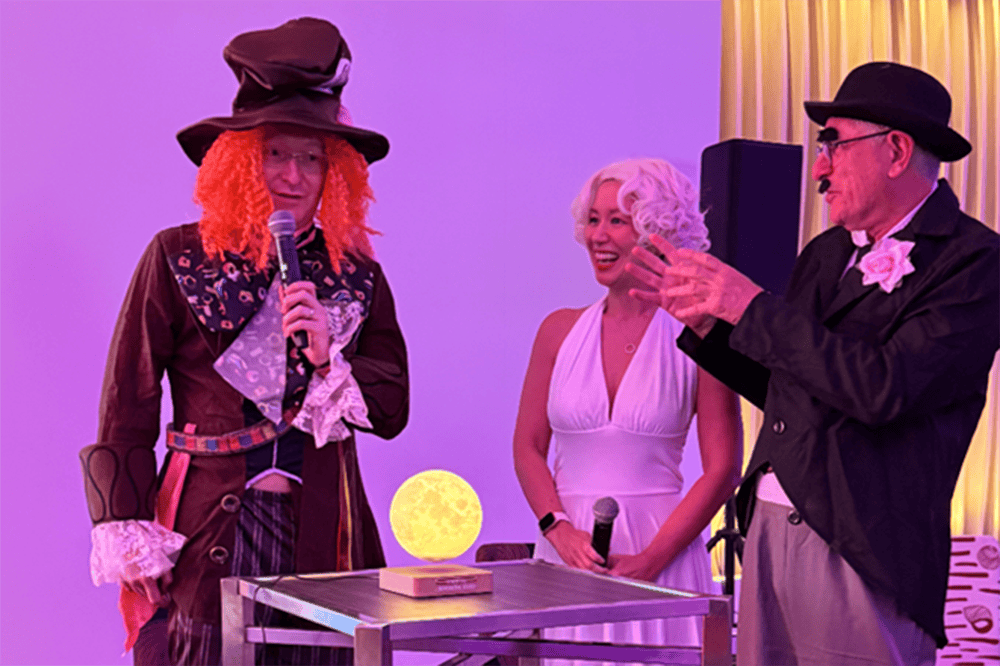
As hosts of this session, Prof Barrett as Charlie Chaplan and Dr Andrea Ang (Perth) as Marilyn Munroe, excelled in their amazing costumes. Along with the panel of judges they duly awarded a proud Dr Lockington the winner’s trophy for his great video and entertaining explanation. His Hungry Hippos video dealt with the issues surrounding retained lens fragments in IOL surgery, including his techniques on how to remove them safely. It was a tough call as all the video presentations, fancy dress, and live commentary were all top shelf.
After the decades long reign by AUSCRS cofounders, Prof Barrett and Dr Wolfe, Prof Sutton and Dr Beltz have very ably co-chaired AUSCRS for the past three years. Prof Sutton had indicated that he would help transition AUSCRS for a limited period of three years. It was therefore announced that Dr Ang would now share the lead of AUSCRS with Dr Beltz, supported by a capable AUSCRS committee. Dr Ang said she was “truly honoured and excited” and looked forward to “contributing to the continued growth and strength” of the AUSCRS community.
“AUSCRS is built on a foundation of support, mentorship, and camaraderie, and I can’t wait to see what we’ll achieve together in the years ahead,” Dr Ang concluded.
AUSCRS 2025 was held in July. The meeting closed with the big reveal, letting us all know to book time off to attend ‘The Sound of AUCSRS’ 2026 on the Sunshine Coast, 15–18 July 2026. Visit: auscrs.org.au/2026-conference.
Alan Saks is a retired optometrist. He is the Chief Executive Officer of the Cornea and Contact Lens Society of Australia, and a regular contributor to mivision.



| Dayne Geber Farewells Community |
|---|
| Medical representative Dayne Geber took the opportunity to fearwell colleagues and competitors while at AUSCRS. After working within the ophthalmic community for 39 years, across three countries and in three different companies, he said he leaves with strong friendships, wonderful memories, and a deep sense of gratitude. |
References
- Norrby S. Sources of error in intraocular lens power calculation. J Cataract Refract Surg. 2008 Mar;34(3):368-76. doi: 10.1016/j.jcrs.2007.10.031. PMID: 18299059.
- The Prospective Health Assessment of Cataract Patients’ Ocular Surface (PHACO) study: the effect of dry eye Trattler W. Majmudar P, Donnenfeld E. McDonald M. Stonecipher K. Goldberg D. Clin Ophthalmol; 2017. doi: 10.2147/OPTH.S120159.eCollection 2017