


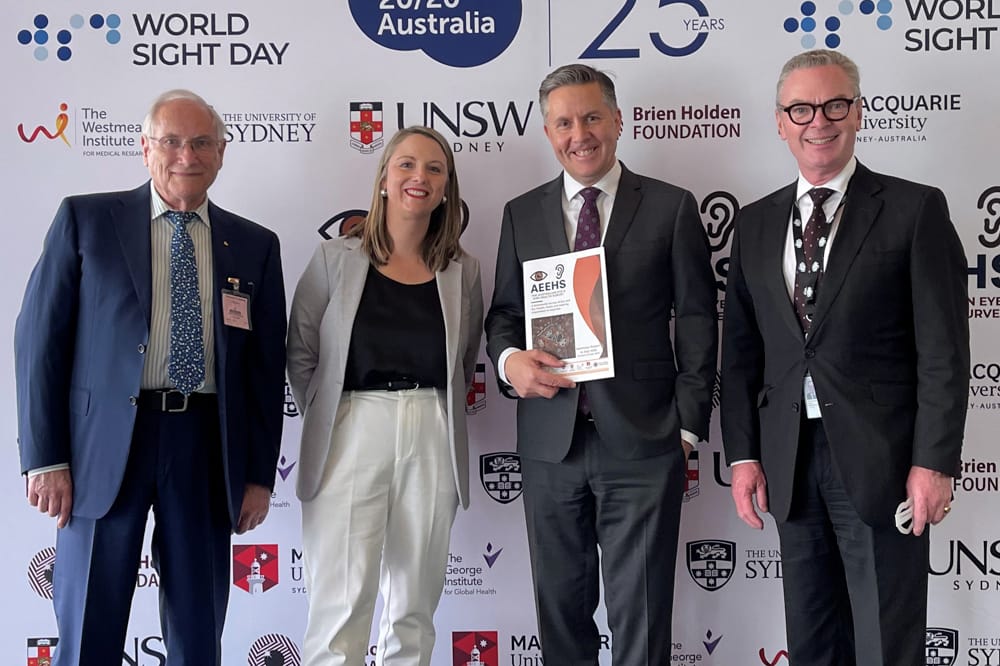
Prof Paul Mitchell - Director of the Centre For Vision Research at The Westmead Institute for Medical Research, Carly Iles, CEO of Vision 2020 Australia, The Minister for Health and Ageing, the Hon Mark Butler MP, and the Hon Christopher Pyne, Chair of Vision 2020 Australia.
A nationwide study assessing both eye and ear health has found measurable improvements in the rates of vision impairment among Australians, but continuing disparities between Indigenous and non-Indigenous populations.
The Australian Eye and Ear Health Survey (AEEHS) found one in seven Indigenous Australians aged 50 or over have some form of vision loss, while the rate for non-Indigenous Australians is one in 10.
The AEEHS examined 4,519 Australians aged 50+ across 30 sites in all states and territories – including remote areas – between August 2022 and March 2025.
Of these, 617 participants (13.6%) identified as Indigenous and 3,902 (86.4%) as non-Indigenous. The survey achieved a 73.7% response rate from more than 18,000 households approached. For the hearing survey, 3,573 of the 4,519 eye study participants were recruited, of whom 461(12.9%) were Indigenous and 3,112 (87.1%) were non-Indigenous.
… one in seven Indigenous Australians aged 50 or over have some form of vision loss, while the rate for non-Indigenous Australians is one in 10.
The survey, described as the “most comprehensive study of its kind”, builds on the previous National Indigenous Eye Health Survey in 2008 the National Eye Health Survey in 2015–2016.
The results show encouraging signs of progress, with reductions in rates of vision impairment across both Indigenous and non-Indigenous Australians since 206, driven by improvements in cataract surgery and refractive error correction.
But, the AEEHS report noted, inequities remain.
The report found prevalence of vision impairment in Indigenous Australia is three times higher than non-Indigenous Australians, while the prevalence of moderate vision impairment is six times higher when comparing the two cohorts.
Bilateral vision impairment was highly age-dependent, with a prevalence of 9.8% (Indigenous) and 2.1% (non-Indigenous) in those aged 50–59 years and increased linearly with age to 19.6% (Indigenous) and 11.7% (non-Indigenous) for those aged 80+ years. However, in every age group, the prevalence of bilateral vision impairment was 2.5 times higher in Indigenous Australians.
The leading causes of bilateral vision impairment were similar for Indigenous and non-Indigenous Australians – uncorrected refractive error and cataract. However, there was a higher rate of diabetic retinopathy among Indigenous Australians, while non-Indigenous Australians had higher rates of age-related macular degeneration.
The highest proportion of bilateral vision impairment in both Indigenous and non-Indigenous Australians was found in remote/very remote areas, where total prevalence was four times higher than other geographical areas.
The survey found that 54% of Indigenous participants and 65% of non-Indigenous participants with diabetes followed national eye examination recommendations. Living in remote areas, increasing age, and having diabetes were identified as key risk factors for vision impairment or blindness.
Hearing Survey
In hearing health, the crude prevalence of bilateral hearing impairment was 50.6% overall, with similar rates among Indigenous (49.0%) and non-Indigenous (50.8%) participants. After age standardisation, rates were 42.8% and 39.4% respectively.
Around 40% of Australians aged 50 and older were found to have some level of hearing loss, and one in seven had moderate or worse impairment. Hearing loss increased significantly with age and was higher in men than women across both Indigenous and non-Indigenous groups.

The Minister for Health and Ageing, the Hon Mark Butler speaking at the AEEHS report launch.
A Guide to Future Policy
The AEEHS report was formally launched in Canberra on World Sight Day by federal Health Minister Mark Butler.
Vision 2020 Australia CEO Carly Iles said the findings underscored the need for continued national leadership and targeted action.
“This survey provides the evidence base we need to ensure no one in Australia is left behind when it comes to seeing and hearing well. It’s an important reminder that progress is possible, but only if we stay focussed on access, prevention and early intervention.”
The AEEHS was delivered by the Westmead Institute for Medical Research in collaboration with partner universities and organisations across the sector. It was funded by the Australian Government, with additional support from the Martin Lee Centre for Innovations in Hearing Health at Macquarie University and Vision 2020 Australia, which championed the call for this follow-up national survey.
Vision 2020 Australia said the survey’s findings will guide future policy, service delivery and advocacy to further reduce preventable vision loss and hearing impairment across Australia.

