


Heidelberg has showcased advancements in ophthalmic imaging at the 21st International Spectralis Symposium (ISS), which was attended by almost 500 participants from 46 countries and 35 renowned speakers.
A keynote address by NASA astronaut Warren Hoburg and Captain Tyson J. Brunstetter, OD, PhD, titled ‘Journey into Space: Völlig losgelöst’ was a highlight of the symposium. The keynote shared clinical insights on in-orbit ocular testing and Space Flight Associated Neuro‑Ocular Syndrome (SANS), highlighting the incorporation of a SPECTRALIS optical coherence tomographer (OCT) aboard the ISS since 2013 and the delivery of a second SPECTRALIS with OCT 2 Module in 2018.
NASA’s SANS clinical lead, Dr Brunstetter, delineated how advanced multimodal SPECTRALIS imaging has reshaped our understanding of SANS, linking ocular changes to long-duration spaceflight.
Professor Frank Holz from Germany’s University of Bonn, served as Symposium Chair. Sessions highlighted the power of high-resolution OCT in distinguishing key age-related degeneration (AMD) biomarkers which are essential for individualised AMD treatment and advocated for bringing SPECTRALIS-enabled retinal services closer to patients.
Dr Brunstetter, delineated how advanced multimodal SPECTRALIS imaging has reshaped our understanding of SANS, linking ocular changes to long-duration spaceflight
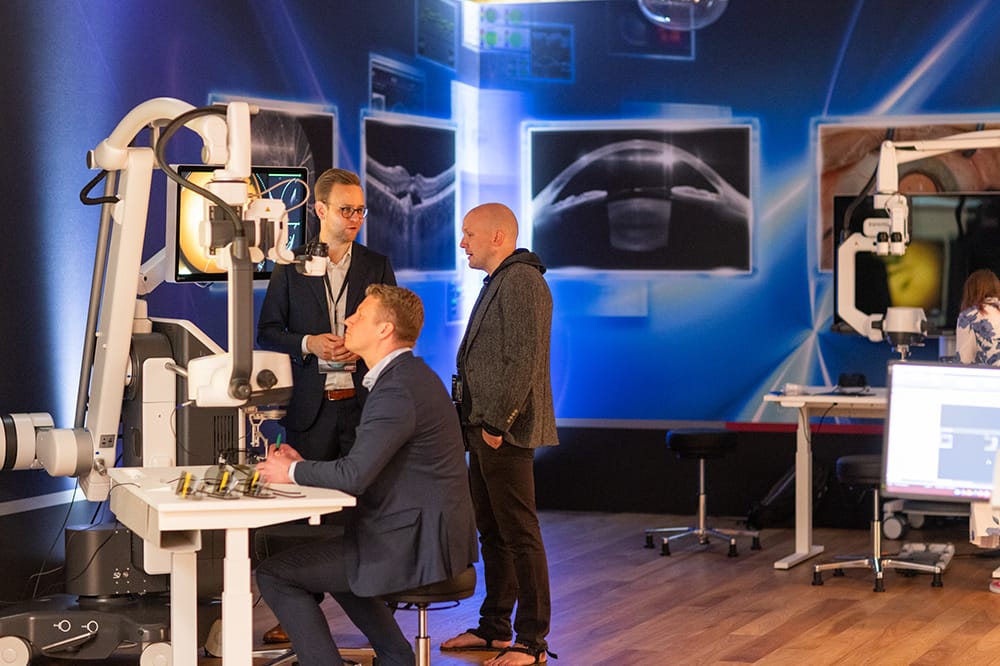
For the first time, ISS 2025 also featured live demonstrations of innovations Heidelberg Engineering is currently working on – offering a sneak peek at cutting-edge technology in action. Especially well-received was SeeLuma – a fully digital surgical microscope that will integrate intraoperative OCT with digital 3D heads-up displays and user-friendly ergonomics for precision-guided retinal surgery.
The symposium also welcomed representatives of Heidelberg Engineering’s majority shareholder EssilorLuxottica, supporting their joint mission of advancing eye care worldwide.
The symposium was hosted at the new Heidelberg Congress Center, in the new Heidelberg Germany.


