


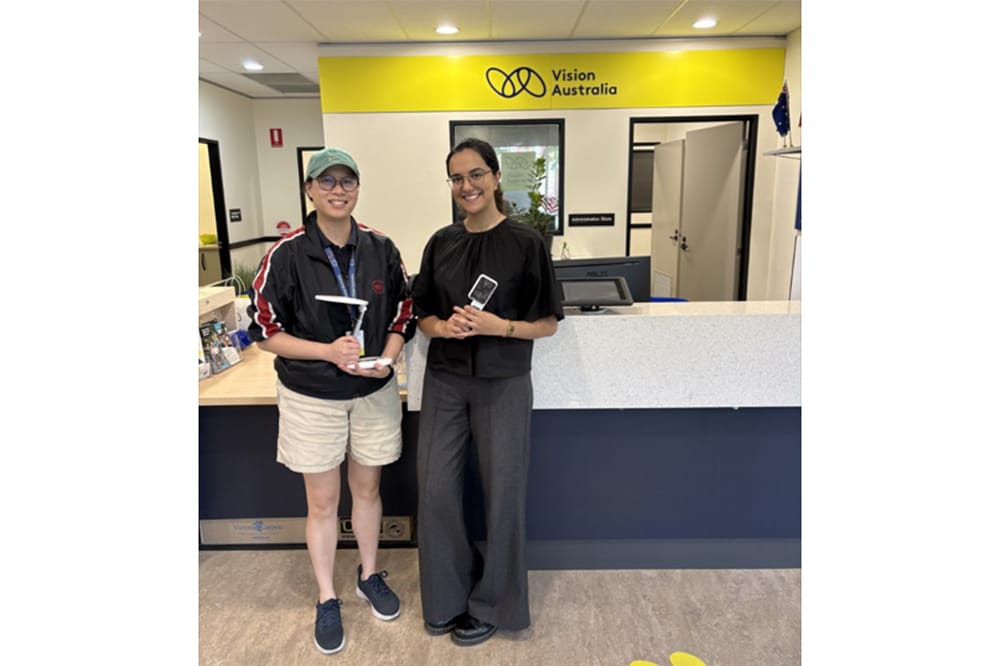
Ibtisam Shahbaz with a team member from Vision Australia
Ibtisam Shahbaz, a final-year optometry student at Deakin University, writes about her experience observing a glaucoma patient with low vision in their home environment. The article is timely, with World Glaucoma Week running from 8 – 14 March 2026.
As a final-year optometry student, much of my clinical training has taken place in consulting rooms, where vision is measured in charts and numbers. Recently, I was fortunate to participate in a clinical experience that extended beyond the everyday clinic door.
The opportunity I had was to join a home visit in regional Victoria, one hour north fro
m Bendigo, with an orthoptist and an occupational therapist from Vision Australia.
For me… this visit was a turning point. It reminded me to see patients as people living complex lives shaped by their environments, routines and values
We visited a farm to meet a patient living with advanced glaucoma. In the familiarity of his own home, the real-world impact of vision loss became immediately clear. He described difficulty recognising faces, difficulty walking around the house, and a heightened fear of falling. Though we learn about these symptoms by textbook, hearing this patient’s lived experience gave me a deeper level of understanding and empathy.
Within his living room, low vision care transformed from theory into something personal. The patient was an enthusiastic audiobook listener, so we introduced him to the Vision Australia app and a tabletop device that could read content aloud. We demonstrated handheld magnifiers to assist with mail, letters, and bills, and explored practical strategies such as high-contrast labels, tactile rubber bands to identify pantry items, and camera-to-speech technology to help him determine what was in the fridge. The guiding principle throughout was simple: bigger, bolder, and brighter.
What struck me most was the difference it made for the patient to trial these aids in his own personal space. Seeing how he would use them, rather than imagining their benefit in a clinic, highlighted the true value of home-based care. These interventions were not about restoring sight, but about restoring quality of life.
This experience also reinforced the critical importance of interdisciplinary collaboration. An ophthalmologist had provided surgical management, an optometrist refractive support, and the orthoptist and occupational therapist with me on the visit, supported daily function through low vision rehabilitation. Together, they formed a model of care that placed the patient at the centre.
Bringing Low Vision to Life
For me as a student, this visit was a turning point. It reminded me to see patients as people living complex lives shaped by their environments, routines and values. It also strengthened my commitment to outreach, to support access to person-centred care for those who need it most!
If optometry is about improving vision, then experiences like this remind us that our true purpose can broaden to improve lives. Sometimes the most meaningful care begins not at the slit lamp, but in the quiet understanding of a patient’s lived experience.
Ibtisam Shahbaz is a final year optometry student at Deakin University.


